Live public website
The redesigned core estate is live across eleven established routes.
ProposalFit is positioned as an AI proposal strategist for creative agencies, supported by a live website, working intake, CRM routing and a governed search-content system. The public platform explains the Fit Score and proposal-teardown method while the commercial product remains clearly labelled as validation-stage. The intended operating context is Product method, public website, CRM, search and publishing. Thomas's role was Product strategist, brand director and website builder. The case follows the product from its main operating problem through Live public website, Working acquisition flow, Mobile and accessibility proof, then connects each interface to a working feature and control. The evidence comes from live routes, form-to-crm proof, browser qa and staged product method. It also records what failed, what changed and how privacy, evidence or approval boundaries are handled. The limit is explicit: no proven customer result, close-rate lift or commercial product adoption.
A direct account of the operating constraint, the product decision and the limits of the evidence.
Proposal software often begins with generation, templates or sending. Creative agencies still face a senior-review problem: does this document answer the brief, show relevant proof, set a credible scope, explain the price and reduce the buyer's risk? Faster output does not solve that judgement gap.
The website had to explain a new category while producing real leads. Early form behaviour looked successful at the interface but did not create a usable CRM record. The site also inherited visual and analytics decisions that did not belong to the venture.
ProposalFit was shaped as a quality layer first. A structured Fit Score creates the method. A live public website explains the wedge and captures interest. Search, analytics and a large staged editorial estate support discovery, but content cannot release until claims, due date and approval are all valid.
| Primary job | Help creative agencies improve proposal quality before the send. |
|---|---|
| Evaluation areas | Brief fit, brand fit, proof, scope, pricing clarity, risk and buyer confidence. |
| Live surfaces | Public website, teardown, Fit Score explanation, sample output, legal pages and lead capture. |
| Operating surfaces | CRM routing, content approval, claims review, search estate and scheduled publisher. |
| Evidence boundary | The acquisition system works; the commercial product and customer impact remain in validation. |
These are observed properties of the working system. They are not claimed percentages, revenue attribution or a guarantee of future performance.
The redesigned core estate is live across eleven established routes.
Lead capture creates or updates a CRM record and routes it into the ProposalFit context.
Desktop and real-mobile checks found no recorded overflow, console or contrast failures after repair.
Search Console, Bing, schema, crawler guidance and consent-aware analytics are operating.
A large editorial estate is staged and releases only when approved, due and unblocked.
The method and acquisition system are demonstrable, while customer outcome and product adoption remain unproven.
Every image preserves the interface purpose and control logic while replacing live people, projects, records and values with staged data.

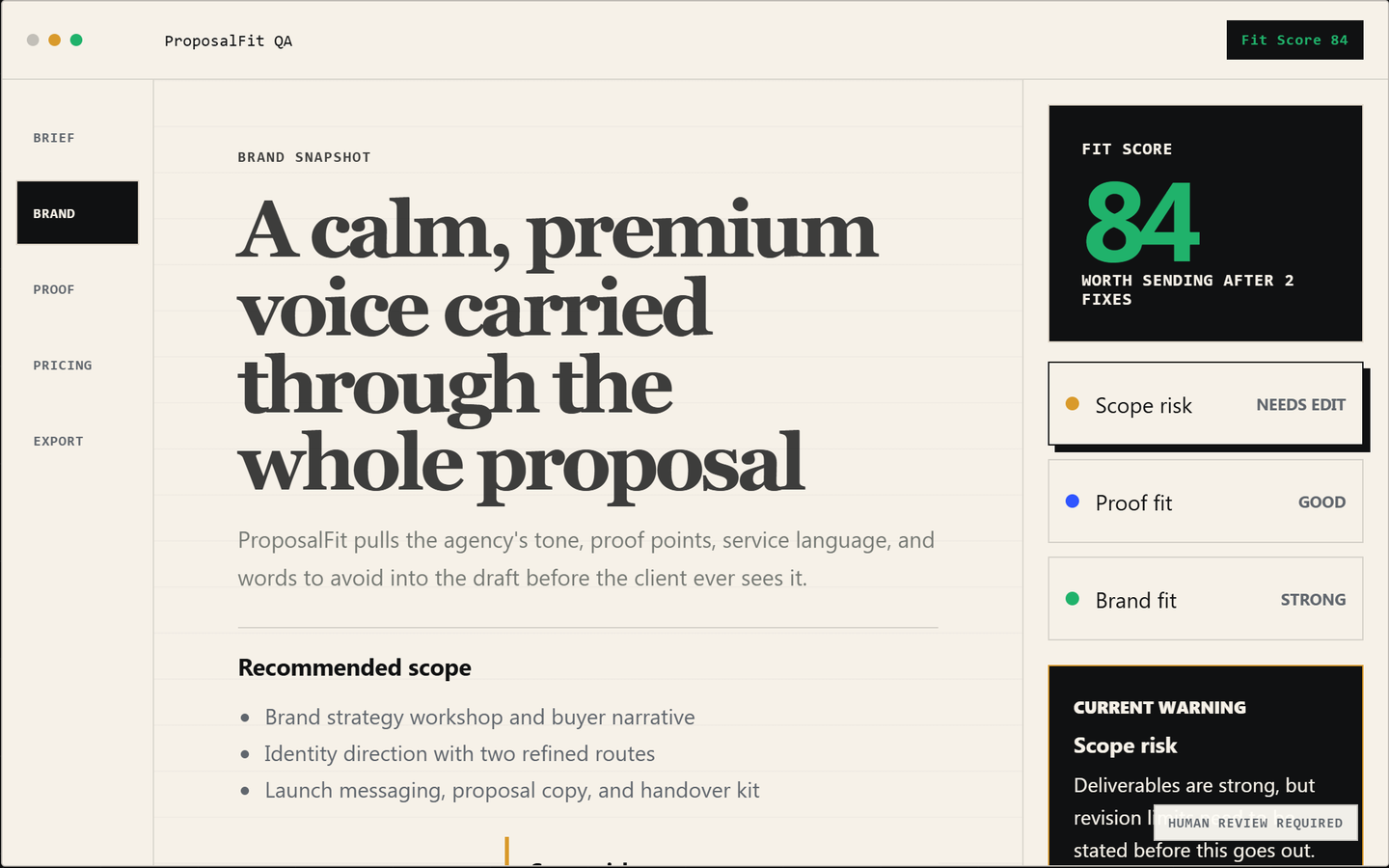
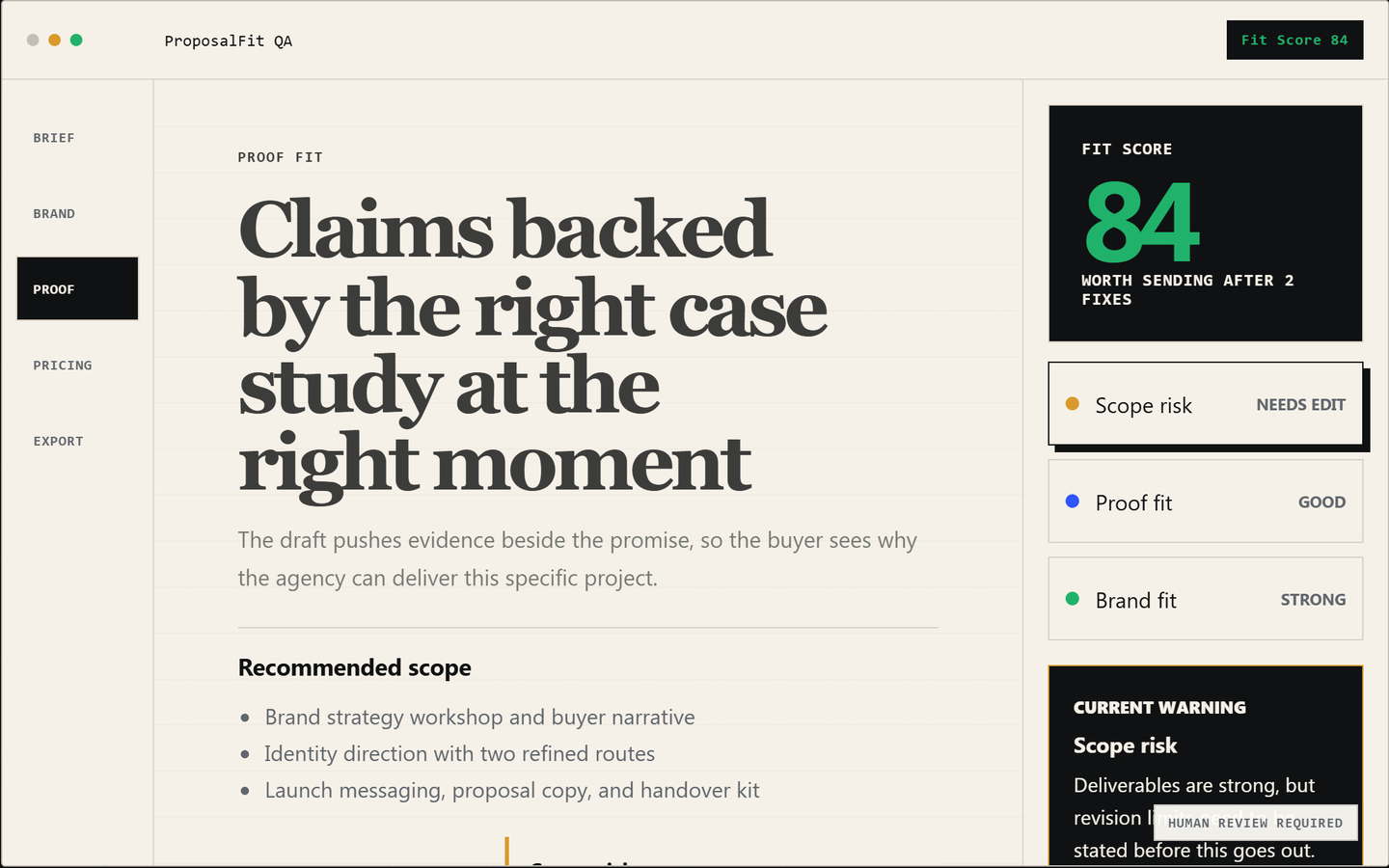
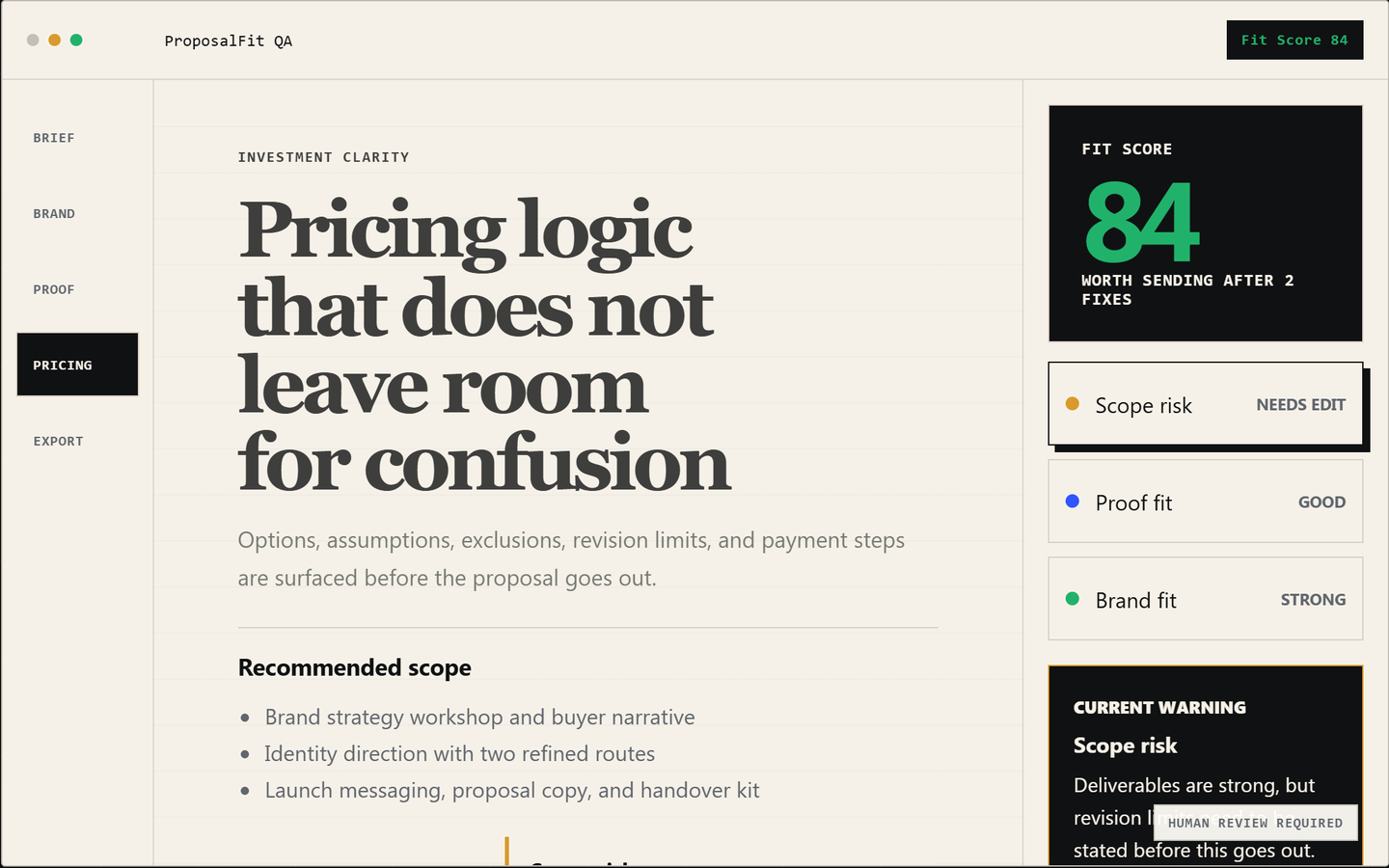
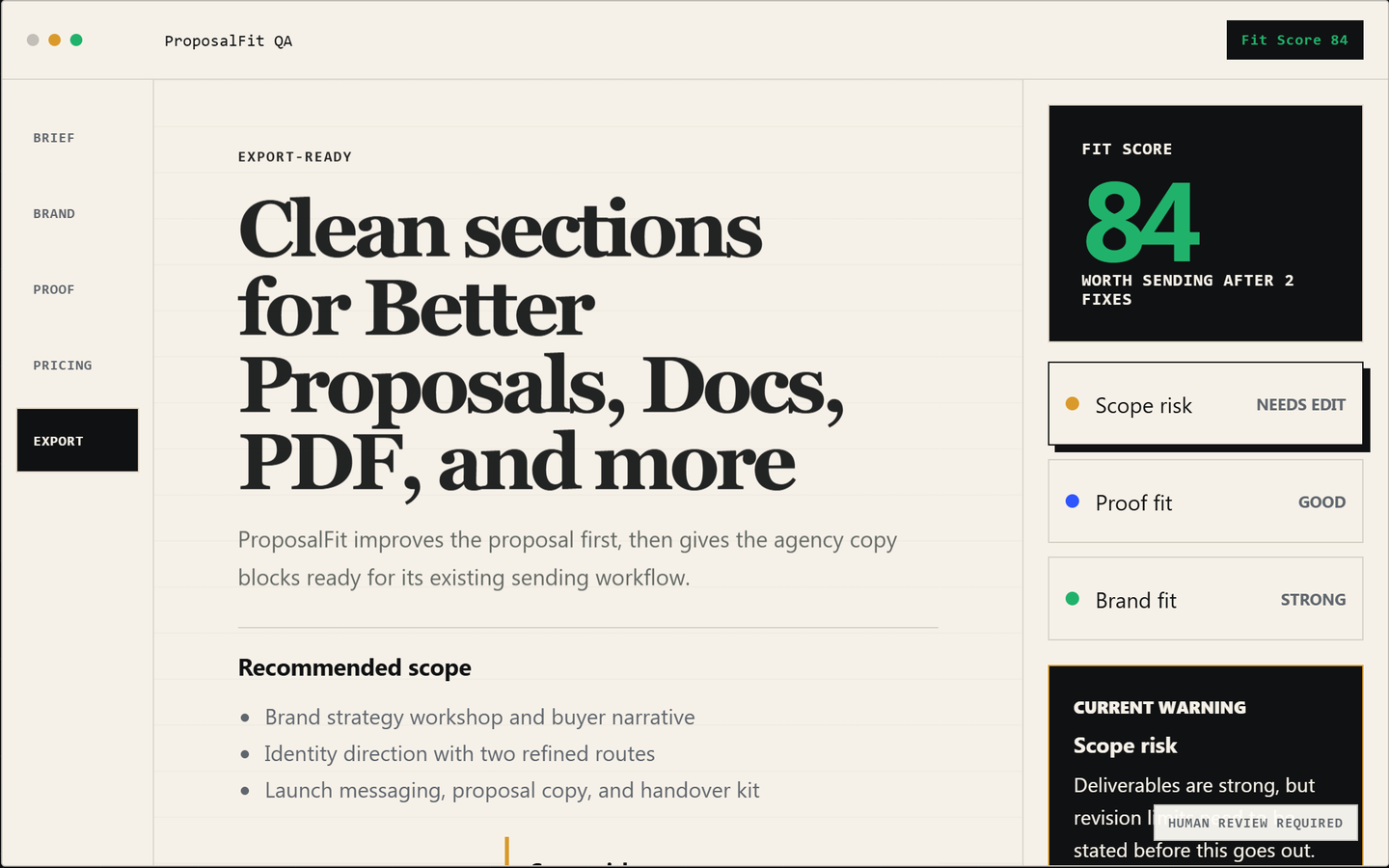

Each entry links to the exact view it describes. Product captures and explanatory diagrams retain their own evidence labels.
The current interactive product preview turns a fictional brief into a structured proposal view.
The current preview keeps brand voice and source evidence visible beside the Fit Score.
The current preview shows where claims need the right case-study evidence.
The current preview makes options, exclusions and revision limits part of the review.
The current preview ends with clean sections for an existing sending workflow and keeps human review visible.
A visual summary connects the main product capabilities to the decisions, controls and user outcomes they support.
The complete working sequence shows how information moves from the first input to a checked and reviewable outcome.
The visible dashboard is only the decision surface. Context, data, permissions, review and learning determine whether it can be trusted.
A structured evaluation turns vague senior judgement into named areas, findings and priorities.
Positioning, samples, teardown and comparison routes explain the quality-before-send wedge.
Safe form fields create a traceable lead without asking for confidential proposal material.
Pillar, glossary, comparison, use-case and factual pages support query and answer-system discovery.
Per-page claims, approval, date and block state determine whether staged content can release.
A useful workflow names the input, owner, check, approval boundary and proof that closes the loop.
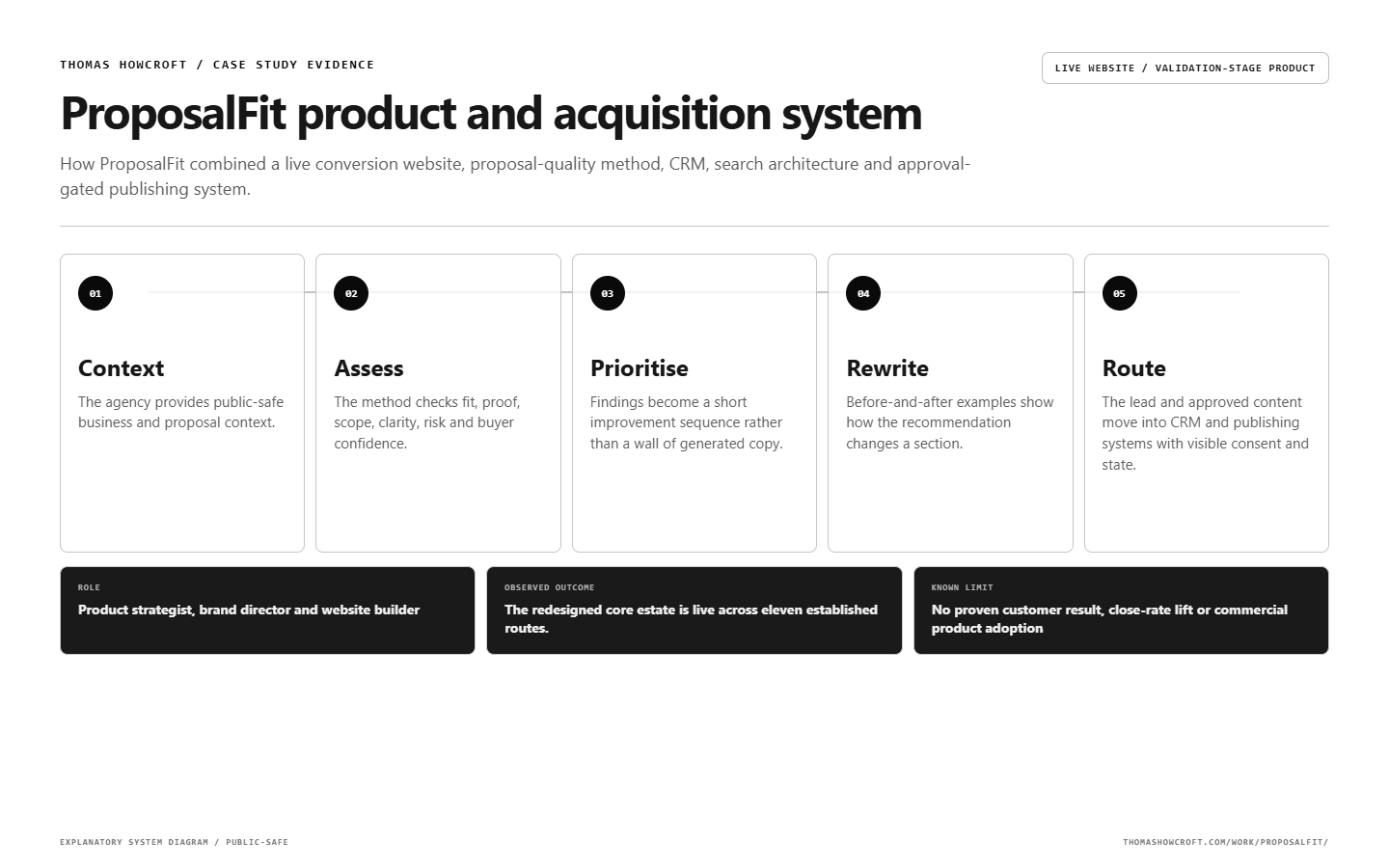
The agency provides public-safe business and proposal context.
The method checks fit, proof, scope, clarity, risk and buyer confidence.
Findings become a short improvement sequence rather than a wall of generated copy.
Before-and-after examples show how the recommendation changes a section.
The lead and approved content move into CRM and publishing systems with visible consent and state.
Each feature exists because it changes a decision, reduces unsafe ambiguity or makes a failure easier to see.
A public-safe intake and sample demonstrate the evaluation without requesting confidential client text.
The method makes brief, brand, proof, scope, price, risk and confidence visible as separate decisions.
Fictional examples show how a finding becomes a stronger section rather than generic AI copy.
Positioning, product pages, comparison, legal and lead routes form a coherent public journey.
Schema, FAQs, semantic pages, sitemaps and crawler support strengthen extractable product context.
Only an approved, due and unblocked page can enter the release path.
The strongest evidence in an operating system is often the failure behaviour. These issues became design constraints and regression checks.
The interface reported success while no useful CRM record existed.
Replace the front-end-only assumption with a verified server-side capture and routing path.
A helper from another venture introduced the wrong measurement context.
Remove inherited identifiers and give ProposalFit its own consent and analytics contract.
The first technical pass did not create a distinct premium product identity.
Run a separate brand and creative redesign rather than treating implementation as art direction.
Page and interaction animation produced a visible click-to-click interruption.
Reduce motion, keep meaningful state transitions and verify first paint and navigation on mobile.
A large search estate could have been pushed live before claims were ready.
Stage pages and require approval, due date and unblocked state before publication.
A public case study should make it easy to see what is working, what remains internal and what has not been proven.
The visuals combine the direct public product page with the real fictional sample teardown. The website and workflow do not prove customer adoption, close-rate improvement or revenue impact.
Strategy, interface, governance and implementation are treated as one operating problem rather than separate deliverables.
Each link adds a different layer of first-hand evidence rather than repeating the same page under another keyword.
Practical answers about the build, its use and its limits.
Its primary position is proposal strategy and quality before the send, not generic first-draft generation.
The public website, lead capture, CRM route, analytics and search foundations are live.
No. The product remains validation-stage and the page does not claim customer or close-rate results.
The public-safe route warns users not to paste confidential client or proposal material.
A buyer-journey, search and measurement audit followed by a prioritised build brief. Handover: the findings, a prioritised plan and the evidence needed to decide the next step. Scope and schedule are agreed after the fit conversation.
Thomas can define the method, build the public experience and connect acquisition, CRM, search and publishing without overstating validation.