Documented scope
The public Measured Results account, updated 29 August 2026, records more than 1,000 public pages modelled by the system. This is coverage, not a count of improved rankings or additional leads.
XO3D ONE Intel turns website audits into prioritised work by connecting pages, findings, source freshness and completion evidence. Thomas Howcroft developed its product direction, SEO method and system design for an estate of more than 1,000 modelled public pages, as recorded in the dated Measured Results account. The problem was audit noise: repeated warnings and a single readiness score could hide which change actually mattered. Intel groups related findings, keeps outcomes separate from readiness, and requires confirming evidence before work closes. This case shows the working overview, page records, actions and scoring method with public-safe data. It demonstrates an audit-to-action workflow, not a proven increase in rankings, AI citations or revenue.
Read the result, source and limits together.
The public Measured Results account, updated 29 August 2026, records more than 1,000 public pages modelled by the system. This is coverage, not a count of improved rankings or additional leads.
The tour connects page readiness, priority actions, source health, history and the scoring model. The captures use demonstration values; they are not a fresh report of the site's search performance.
Findings are grouped by root cause and affected pages. Source freshness and evidence strength remain visible. An action needs a confirming scan or inspection before closure.
Readiness, visibility and commercial outcomes are separate measures. No AI-citation uplift, search growth or revenue attribution is established by the scores shown in these screenshots.
Read the dated scope and evidence limitations
A technical fix can improve readiness without producing a lead or an AI citation. Intel therefore separates what an audit can observe from what search and commercial data can establish. Grouping findings by cause makes the work actionable; a fresh confirming check makes its completion defensible. The score remains a diagnostic signal rather than a promise.
A direct account of the operating constraint, the product decision and the limits of the evidence.
Traditional crawlers are good at producing findings. They are less good at deciding which finding should be fixed first, which source is fresh enough to trust, whether several warnings describe one root cause or whether an action will improve a real user and search outcome.
The goal was to move from audit exports to website operations. Every page should have an identity, property, template, evidence set and history. Related findings should collapse into an action bundle. Priority should consider reach, severity, dependency and confidence, not just the tool's default score.
The system also needed to support AI-search readiness without inventing a magic GEO score. It therefore models the things answer engines can actually use: crawlable pages, clear entities, descriptive structure, accessible content, source consistency and current evidence.
| Primary job | Turn recurring crawl evidence into prioritised website decisions. |
|---|---|
| Main routes | Overview, Outcomes, Traffic, Pages, Actions, Sources, Standards, History and Score model. |
| Detailed walkthrough | Eleven sanitised views covering the estate, evidence, priorities, guardrails and page-level verification. |
| Coverage | A four-figure page estate across main, lab and shop properties. |
| Signals | Technical health, accessibility, entities, freshness, links and AI-search readiness. |
| Public evidence | Actual product views with fictional URLs and issue values. |
These are observed properties of the working system. They are not claimed percentages, revenue attribution or a guarantee of future performance.
Main site, research properties and commerce pages can be filtered without losing their shared templates and dependencies.
Related findings become a prioritised action with scope, owner, evidence and completion proof.
A page shows what changed, which source found it and whether the next scan confirmed the fix.
Crawl, analytics, search and manual evidence keep their provenance and freshness.
Entity clarity, accessibility, structure and current content are assessed as evidence, not a guaranteed citation score.
Commercial opportunity is kept separate from technical readiness so a valuable-looking page cannot hide a broken foundation.
Every image preserves the interface purpose and control logic while replacing live people, projects, records and values with staged data.

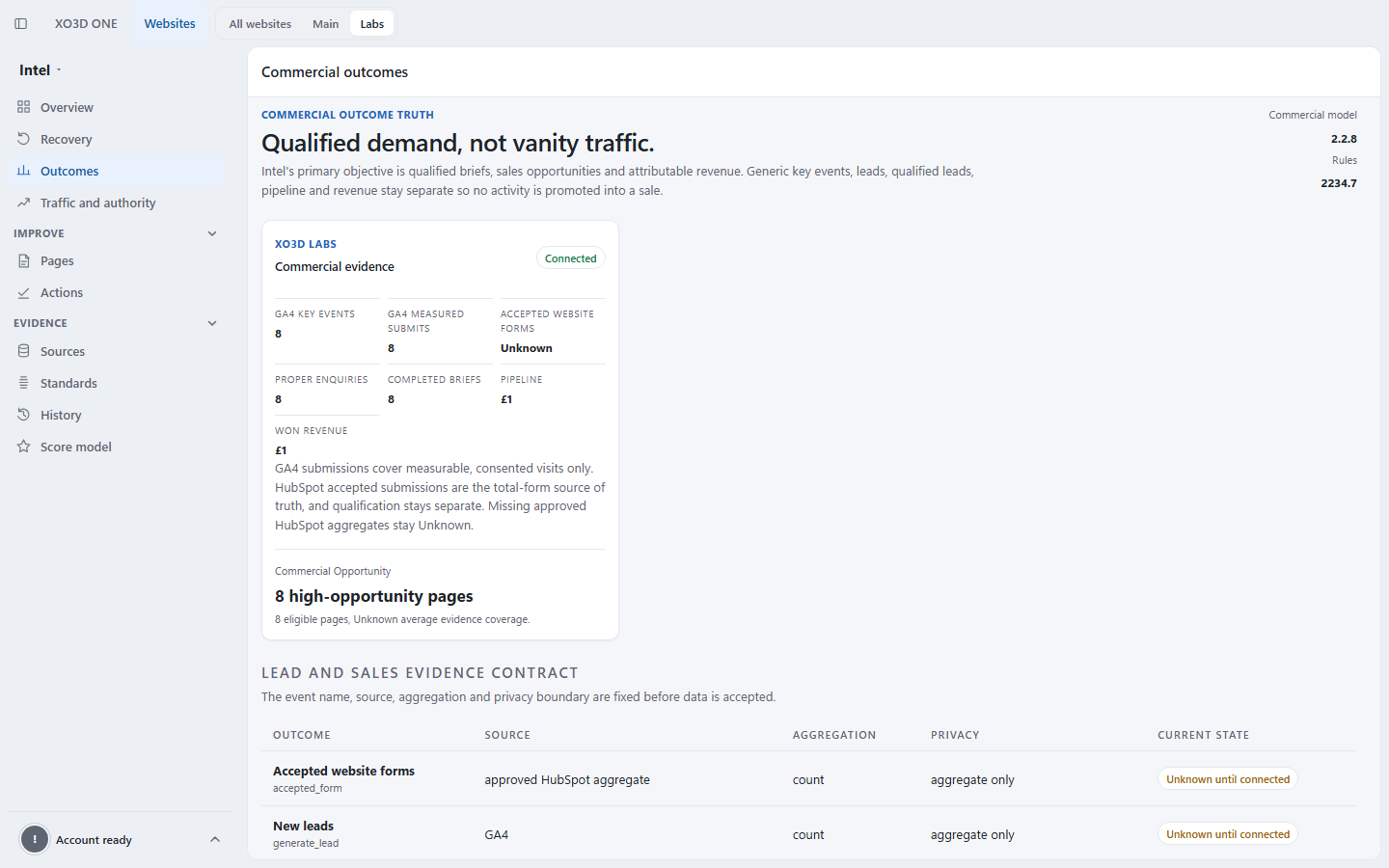

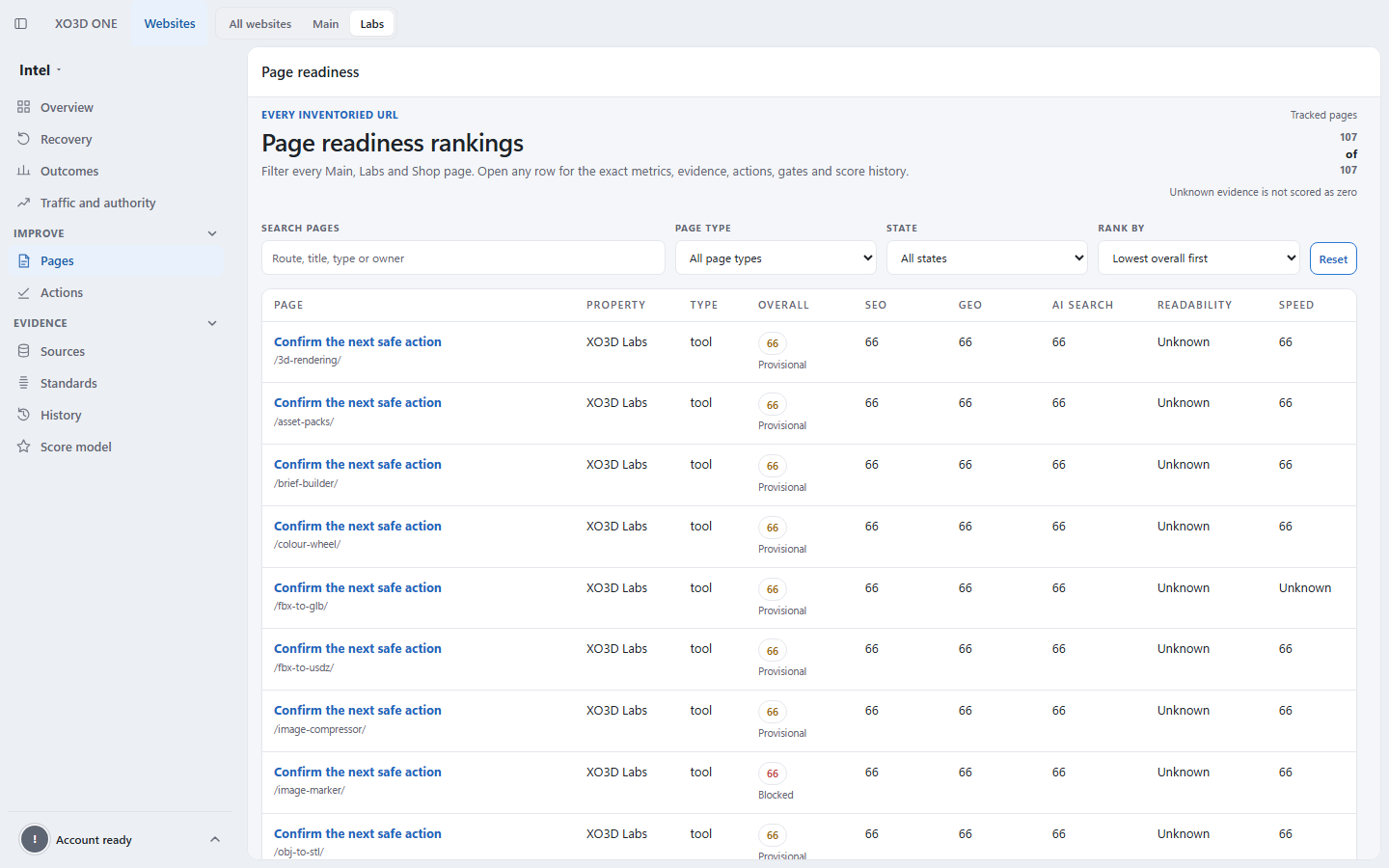
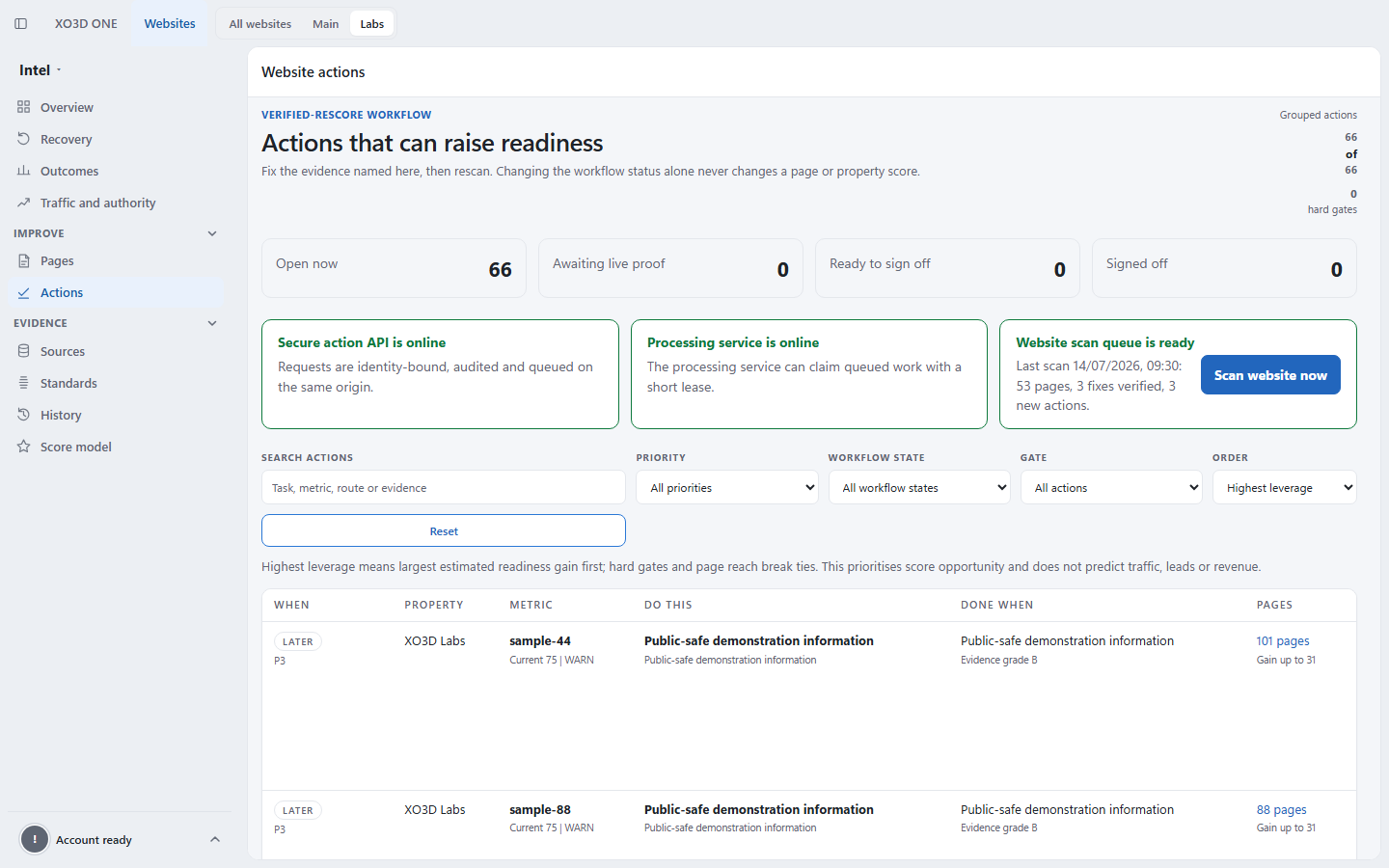
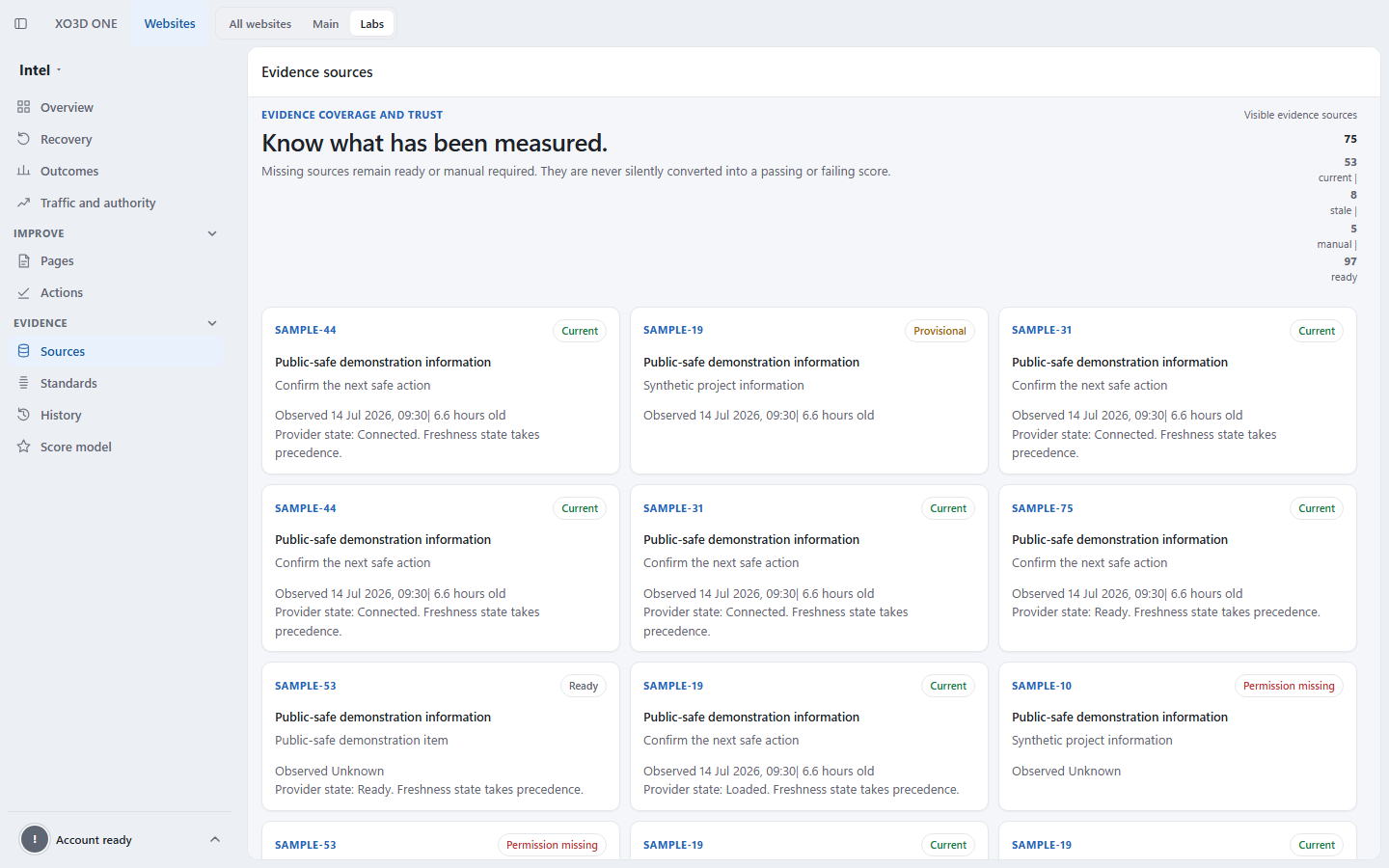

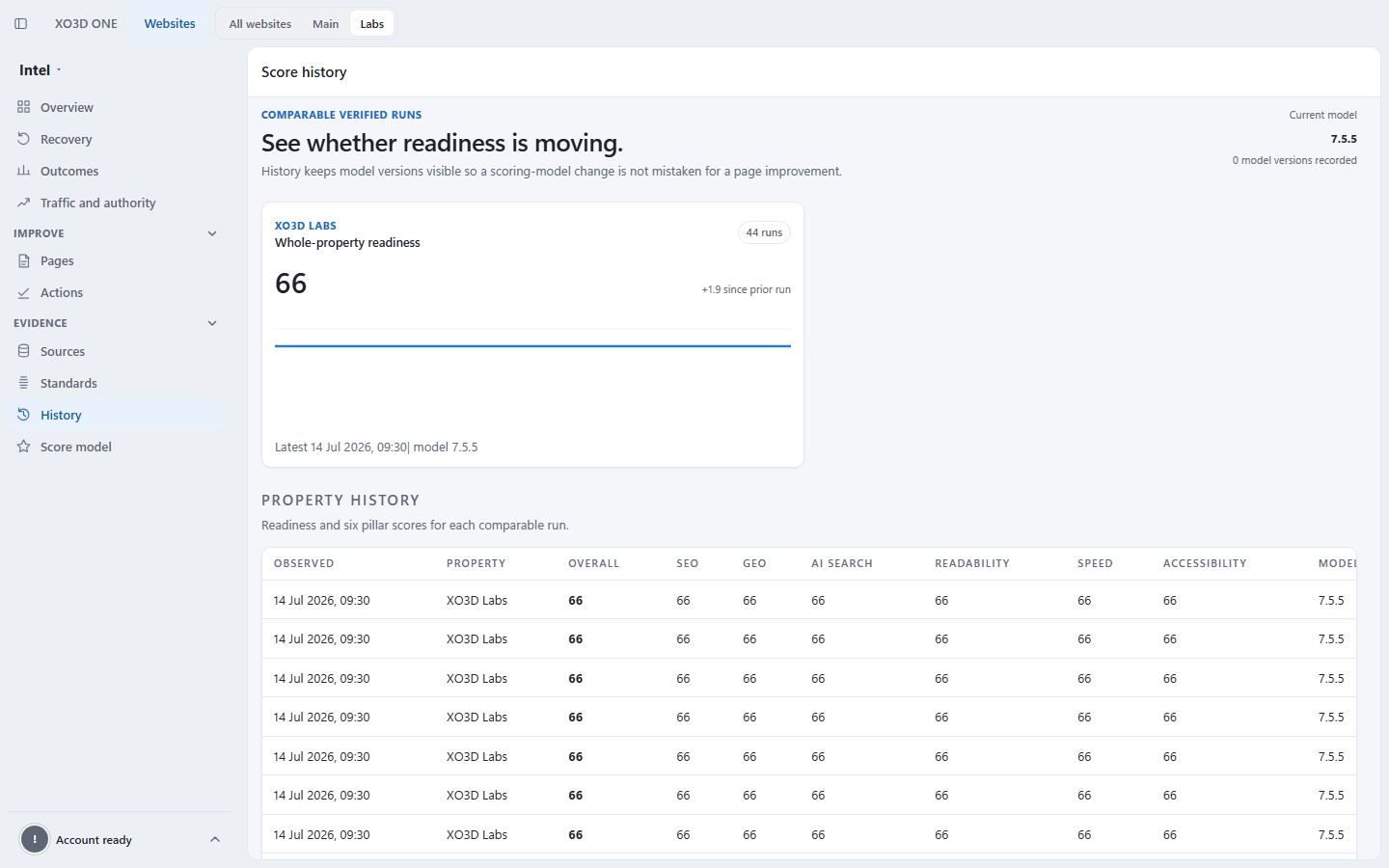


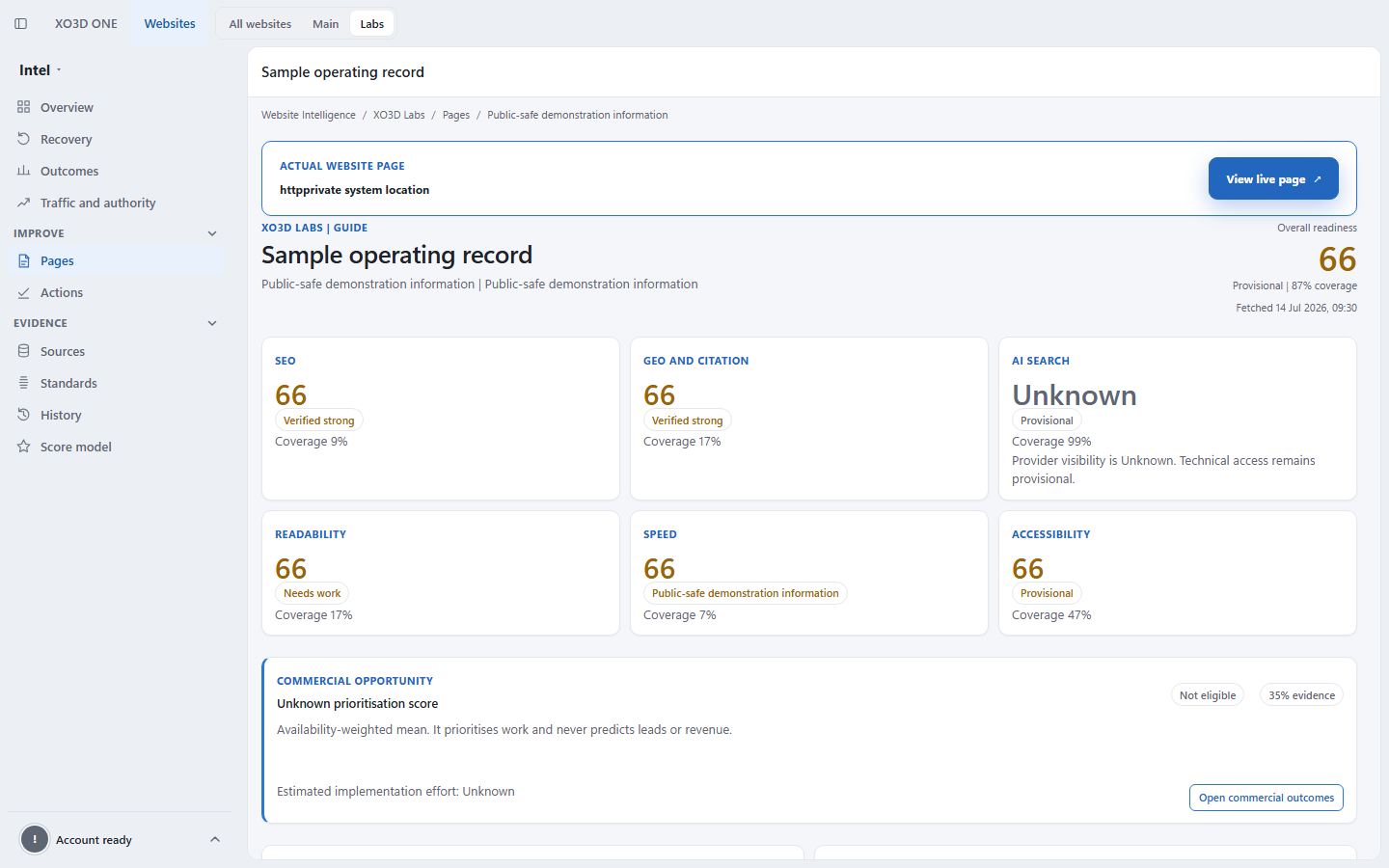
Each entry links to the exact view it describes. Product captures and explanatory diagrams retain their own evidence labels.
The overview separates qualified demand, commercial opportunity and readiness evidence while the switcher shows Intel inside XO3D ONE.
Outcome measures remain separate from readiness scores so traffic, qualified demand and revenue are never implied by technical progress alone.
Search Console, analytics and off-page authority are presented with source boundaries, freshness and honest attribution limits.
Every inventoried URL can be ranked and filtered by property, type and evidence state, then opened as a durable page record.
Related findings become one work package with priority, workflow state, gate, affected reach and the proof required to close it.
Each source declares what it measured, when it ran and whether it is current, provisional, stale or awaiting permission.
The standards view records the current technical, accessibility and AI-search rules used to judge pages and actions.
Comparable runs show whether page and property readiness moved while keeping scoring-model changes visible.
The methodology explains the pillars, evidence grades and fail-closed rules behind every readiness score.
The property drill-in combines pages, actions, source state, opportunity and history for one website without losing the estate context.
A single page record exposes scores, evidence, actions, history and commercial context so a fix can be understood and verified end to end.
The visible dashboard is only the decision surface. Context, data, permissions, review and learning determine whether it can be trusted.
Property, template, health, change and priority signals create a navigable map rather than one score.
Each URL has a durable record for status, template, entity, evidence, issues and change history.
Findings are grouped into work packages with impact, confidence, dependency, owner and proof of completion.
Every data source declares what it observed, when it ran and whether it is current enough for the decision.
Runs can be queued, compared and reviewed so fixes are confirmed rather than assumed.
A useful workflow names the input, owner, check, approval boundary and proof that closes the loop.
Collect permitted crawl, accessibility, search, analytics and manual evidence.
Attach the evidence to durable pages, properties, templates and entities.
Combine related findings into a root-cause action rather than duplicating warnings.
Rank by reach, severity, confidence, dependency and likely decision value.
Rescan or inspect the affected pages and record proof before closing the action.
Each feature exists because it changes a decision, reduces unsafe ambiguity or makes a failure easier to see.
Estate shape, high-leverage opportunities, recent change and current scan state.
Qualified demand, conversions and revenue evidence held separately from readiness signals.
Organic visibility, analytics and off-page evidence with source and attribution boundaries.
URL-level records with property, template, entity, accessibility and source evidence.
Grouped work packages ranked by impact, confidence, dependency and affected reach.
Crawl, analytics, search and manual evidence with clear freshness and ownership.
The technical, accessibility and AI-search guardrails used to judge evidence consistently.
Comparable runs and page-level change records that show whether a fix held.
Visible pillars, evidence grades and fail-closed rules behind every readiness score.
Main, Labs and Shop views plus template, issue, entity and freshness filters.
The strongest evidence in an operating system is often the failure behaviour. These issues became design constraints and regression checks.
Large crawls produced hundreds of repetitive warnings.
Group findings by root cause, template and affected population before creating work.
A single health score hid the difference between reach, severity and confidence.
Use multiple explicit signals and show the evidence that produced each priority.
An old crawl could conflict with a newer manual fix or search record.
Keep source time, freshness and provenance visible at page and action level.
A synthetic AI-readiness score could imply citations are predictable.
Measure crawlability, entities, structure, accessibility and evidence, then state that citation remains outside direct control.
An action could be marked done when only the code change was complete.
Require a confirming scan, live inspection or other completion evidence before closure.
A public case study should make it easy to see what is working, what remains internal and what has not been proven.
Every visual is labelled as a direct public product capture or an actual product capture with generic data. This is evidence of design and operating capability, not a promise of rankings, revenue, leads, productivity or a client outcome.
Strategy, interface, governance and implementation are treated as one operating problem rather than separate deliverables.
Each link adds a different layer of first-hand evidence rather than repeating the same page under another keyword.
Practical answers about the build, its use and its limits.
A crawler collects findings. Website Intelligence maintains page identity, sources, grouped actions, priority, ownership and verification across repeated runs.
No. It measures and prioritises factors the website can control. Rankings, traffic, mentions and citations are not guaranteed.
The working system models more than one thousand public pages across several related properties. Exact internal counts can change and are not the point of the case.
A page can look valuable while being technically weak, stale or unclear. Keeping the signals separate prevents opportunity from being mistaken for proof.
Review one website's audit-to-action process. Handover: a grouped issue inventory, an evidence and measurement map, and a prioritised implementation brief. The decision at the end is which fixes to run first and how to verify them. SEO and AI-search delivery runs through TomHow; scope and schedule are agreed after the fit conversation.
Thomas and TomHow can turn technical SEO, AI-search evidence and website change into a maintained decision system with clear owners and proof.