A repeatable research path
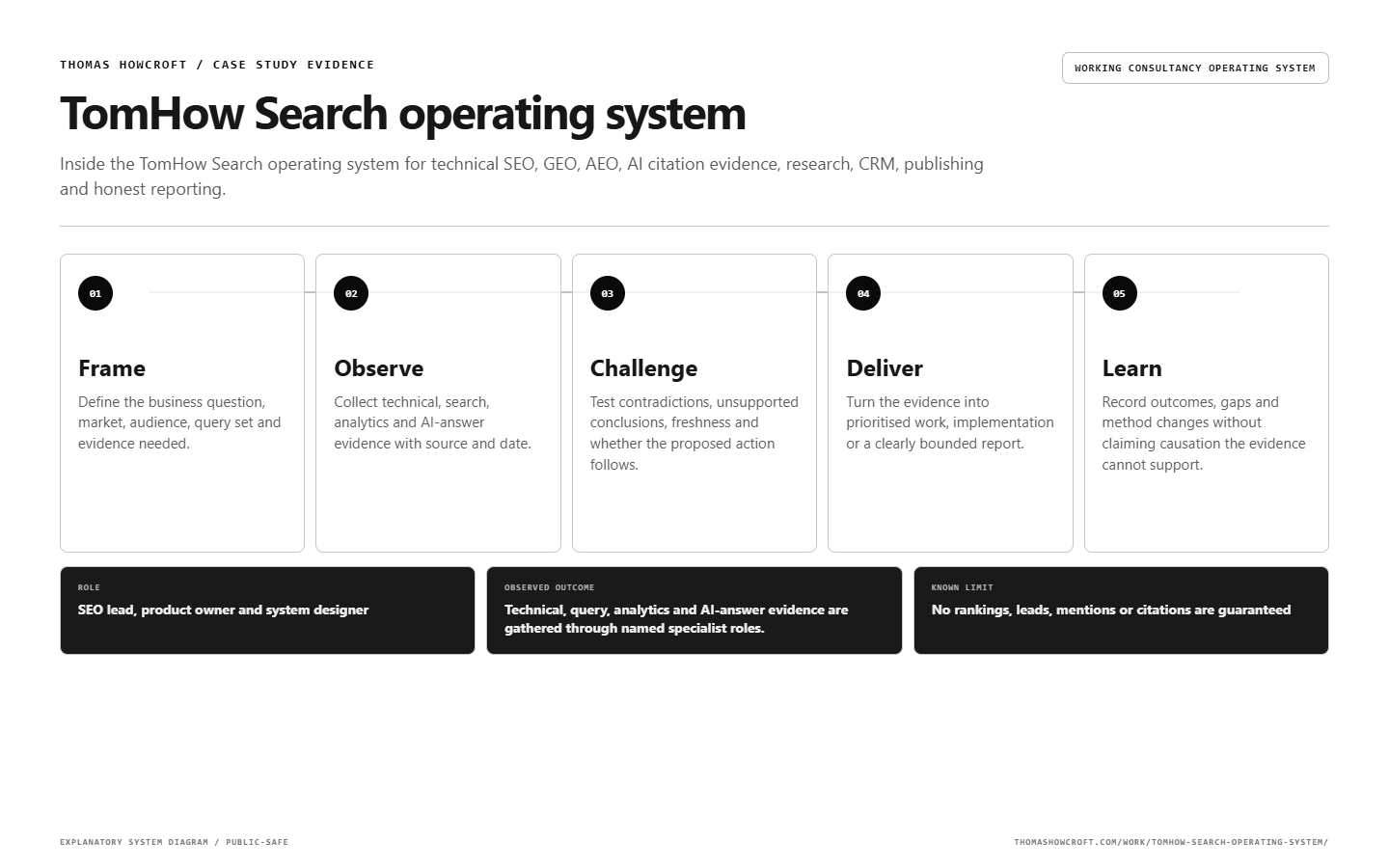
Technical, query, analytics and AI-answer evidence are gathered through named specialist roles.
TomHow's Search operating system connects technical SEO, AI-search research, client work, publishing, CRM and outcome review. Specialist tools gather evidence, challenge claims and prepare actions, while rankings, traffic, leads and AI citations remain outcomes to observe rather than promises to sell. The intended operating context is SEO, GEO, AEO and AI-search delivery. Thomas's role was SEO lead, product owner and system designer. The case follows the product from its main operating problem through A repeatable research path, Claims stay bounded, Delivery and growth connect, then connects each interface to a working feature and control. The evidence comes from working views, research methods and guarded workflows. It also records what failed, what changed and how privacy, evidence or approval boundaries are handled. The limit is explicit: no rankings, leads, mentions or citations are guaranteed.
A direct account of the operating constraint, the product decision and the limits of the evidence.
Technical crawlers, keyword tools, Search Console, analytics and AI-answer tests each observe a different part of visibility. Copying their outputs into a report can create a false sense of one truth, especially when dates, markets, query methods and evidence quality differ.
The operating goal was to preserve the evidence chain. A finding should say which source observed it, when, under which method and what it can justify. A recommendation should state its confidence and dependency. A report should keep measured evidence separate from forecasts, explanations and sales language.
TomHow's system joins delivery with the work around delivery: operating plan, CRM, orders, publishing, LinkedIn review, outcomes and a private Ask surface. This matters because a strong method can still fail commercially if work, follow-up and learning stay in disconnected tools.
| Primary job | Create a repeatable route from search evidence to a defensible action. |
|---|---|
| Primary areas | Home, Growth, Work, Insights and Ask. |
| Supporting views | CRM, Money, Orders, LinkedIn, Publish and Outcomes. |
| Search Lab roles | Research, crawl, analytics, citation, writing, challenge and reporting specialists. |
| Public evidence | Staged brands, queries, contacts and values only. |
These are observed properties of the working system. They are not claimed percentages, revenue attribution or a guarantee of future performance.
Technical, query, analytics and AI-answer evidence are gathered through named specialist roles.
Every report distinguishes observation, interpretation, recommendation and unproven outcome.
Research, work, CRM, publishing and outcome review sit in one operating model without merging private records.
Articles and LinkedIn drafts can be prepared and reviewed without turning draft approval into automatic publication.
Mentions, citations and source behaviour are recorded with query method and date rather than sold as a guaranteed score.
Outcomes and failed assumptions return to the research and delivery method.
Every image preserves the interface purpose and control logic while replacing live people, projects, records and values with staged data.

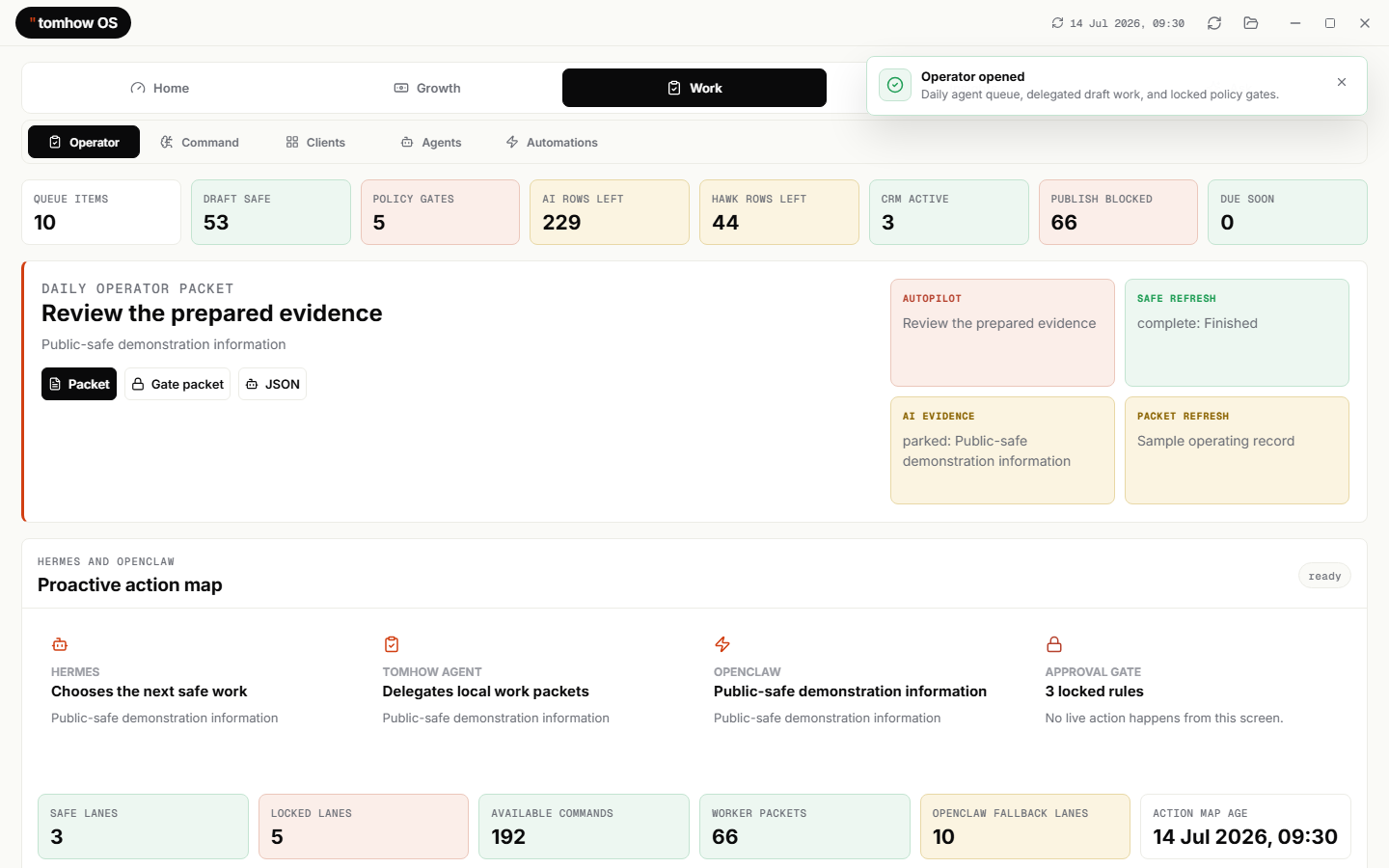
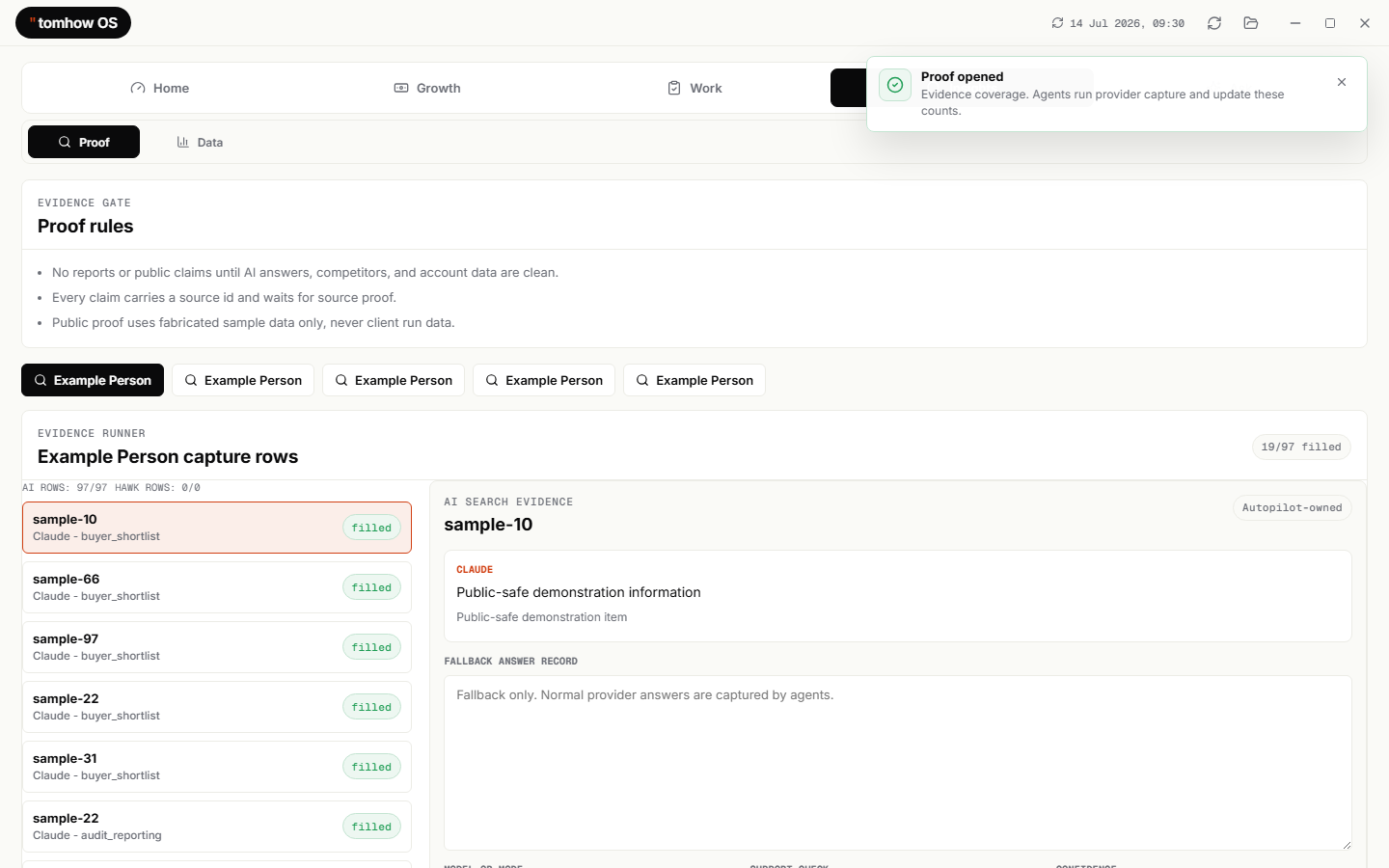
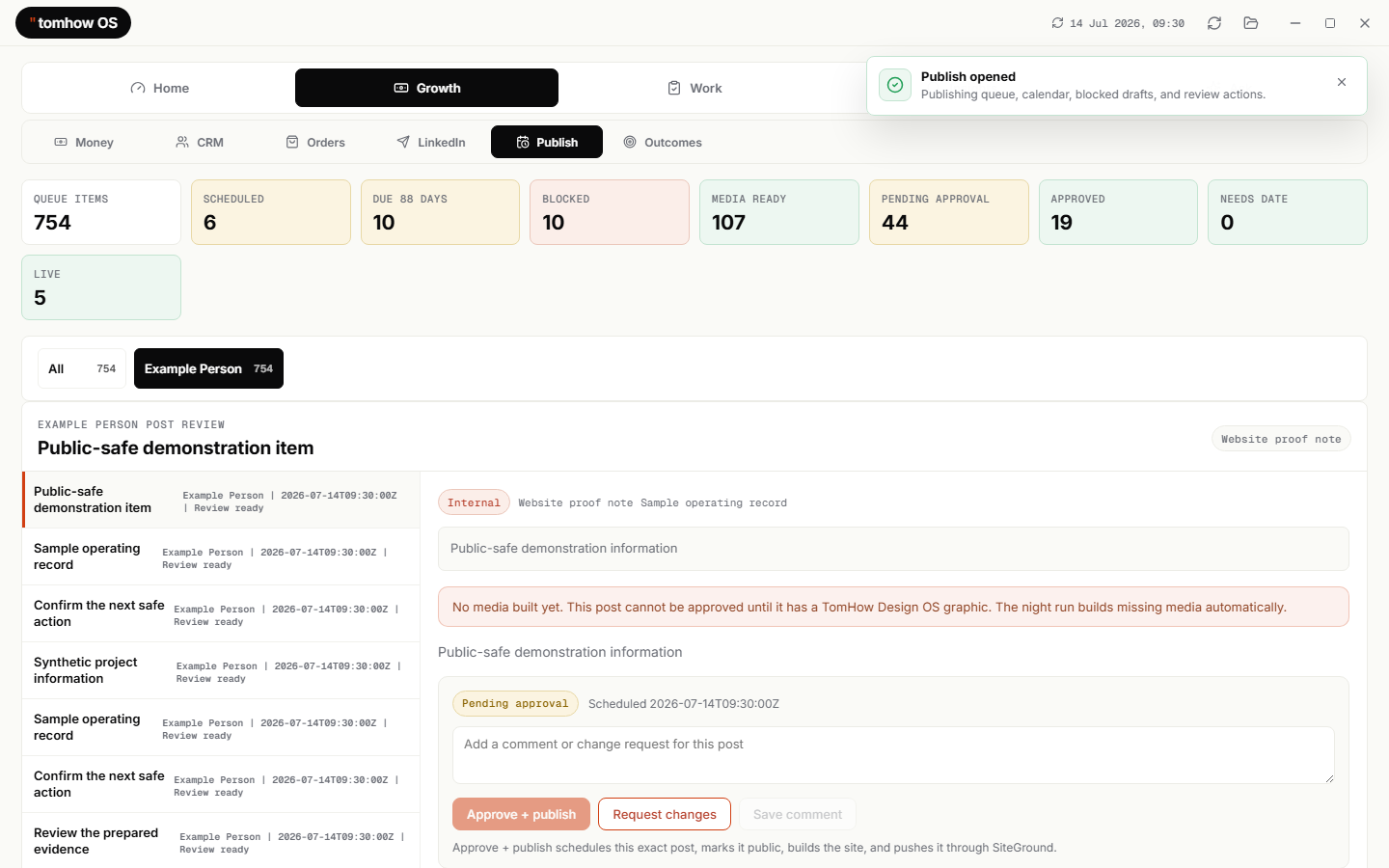
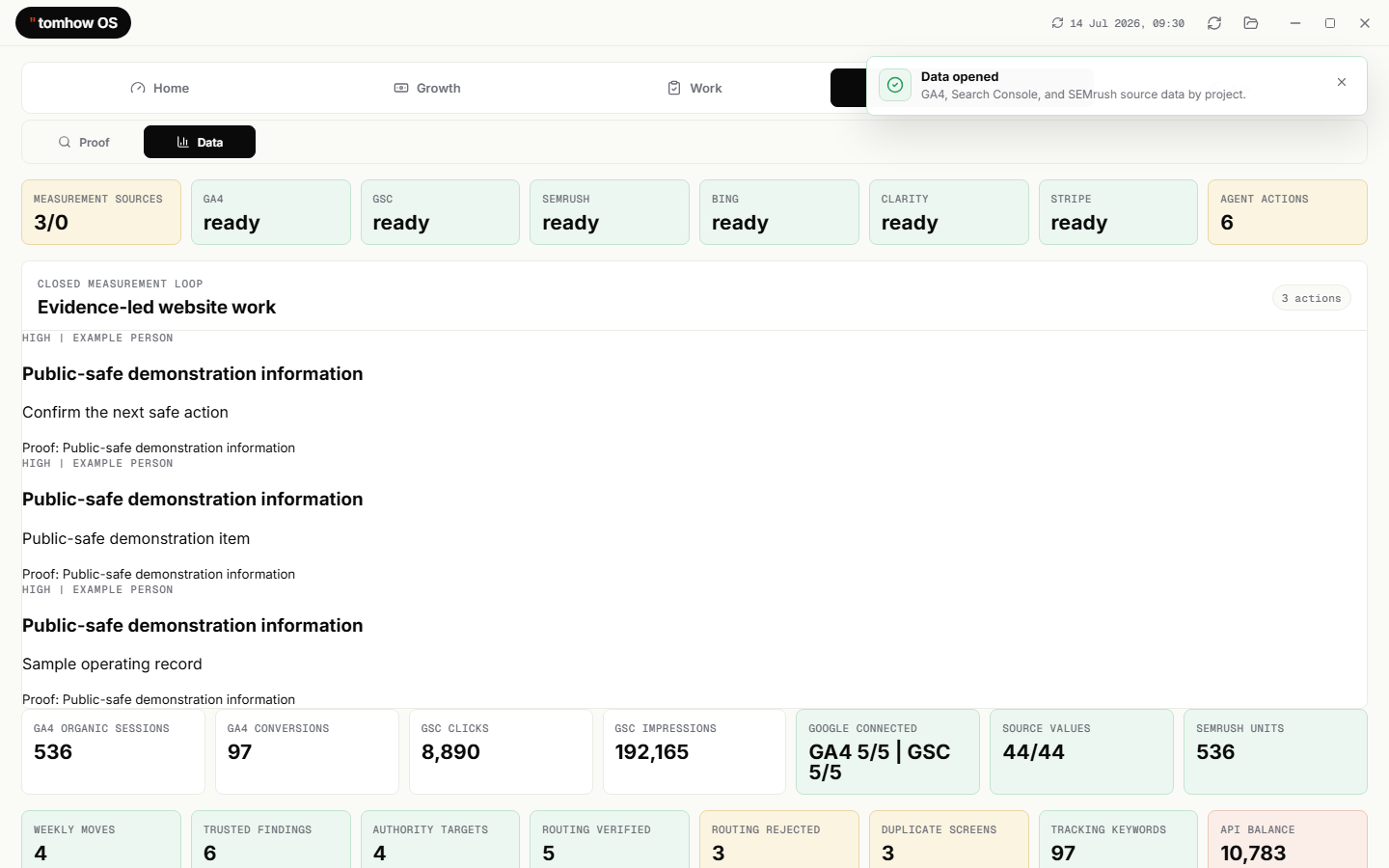

Each entry links to the exact view it describes. Product captures and explanatory diagrams retain their own evidence labels.
The current objective, evidence gaps and highest-value decisions share one staged view.
The actual operator view separates delegated draft work from locked policy gates.
The actual proof view shows coverage, source state and evidence gaps.
The actual publishing view keeps prepared work behind review.
The actual data view separates measured sources, freshness and known gaps.
A visual summary connects the main product capabilities to the decisions, controls and user outcomes they support.
The complete working sequence shows how information moves from the first input to a checked and reviewable outcome.
The visible dashboard is only the decision surface. Context, data, permissions, review and learning determine whether it can be trusted.
Operating plan, priorities, evidence freshness, decisions and the next highest-value work.
Staged CRM, Money, Orders, LinkedIn, Publish and Outcomes views connect demand with delivery.
Research and implementation move through a clear brief, source set, challenge and approval path.
Technical, search, analytics and AI-answer evidence are compared without erasing their different methods.
A private search interface answers from permitted evidence and shows the limits of what it found.
A useful workflow names the input, owner, check, approval boundary and proof that closes the loop.
Define the business question, market, audience, query set and evidence needed.
Collect technical, search, analytics and AI-answer evidence with source and date.
Test contradictions, unsupported conclusions, freshness and whether the proposed action follows.
Turn the evidence into prioritised work, implementation or a clearly bounded report.
Record outcomes, gaps and method changes without claiming causation the evidence cannot support.
Each feature exists because it changes a decision, reduces unsafe ambiguity or makes a failure easier to see.
Shows the current objective, evidence gaps, decisions and scheduled work.
Specialist research roles for crawl, queries, analytics, citations, writing, challenge and reporting.
Staged CRM, orders, commercial review and follow-up without mixing private contacts into public evidence.
Article and LinkedIn preparation with separate review and exact publication approval.
Records what changed and what remains uncertain without converting correlation into causation.
Answers from permitted source evidence and reveals freshness, conflicts and missing proof.
The strongest evidence in an operating system is often the failure behaviour. These issues became design constraints and regression checks.
Different sources reported different values for the same-looking question.
Preserve source, date, market and method. Do not merge unlike measures into a synthetic truth.
A one-off AI answer could be presented as stable visibility.
Repeat defined query sets, record the model and date, save cited sources and state sampling limits.
A recommendation could read like a proven business outcome.
Label observation, interpretation, action and expected effect separately.
A reviewed draft could be mistaken for approval to publish.
Keep exact publication approval separate from content review and retain the final payload.
Joining growth and delivery increases the risk of exposing contact records.
Keep public bundles aggregate and staged. Private contacts stay in a restricted local store.
A public case study should make it easy to see what is working, what remains internal and what has not been proven.
Every visual is labelled as a direct public product capture or an actual product capture with generic data. This is evidence of design and operating capability, not a promise of rankings, revenue, leads, productivity or a client outcome.
Strategy, interface, governance and implementation are treated as one operating problem rather than separate deliverables.
Each link adds a different layer of first-hand evidence rather than repeating the same page under another keyword.
Practical answers about the build, its use and its limits.
It is the connected method around research, technical work, prioritisation, publishing, reporting, customer workflow and learning. It keeps evidence and ownership intact between tools.
GEO improves the clarity, accessibility, evidence and entity signals that AI answer systems can use. It does not make citations controllable or guaranteed.
Defined queries are run under a recorded method. Mentions, cited URLs, source behaviour, date and model context are stored so the observation can be repeated and challenged.
No. Rankings, traffic, leads, mentions and AI citations depend on external systems and market behaviour. The work is evidence-led and the limits are stated.
A focused operating diagnostic, evidence map and pilot brief around one high-value decision. Handover: the findings, a prioritised plan and the evidence needed to decide the next step. Scope and schedule are agreed after the fit conversation.
TomHow combines technical SEO, AI-search evidence and practical delivery for B2B brands, with the method and limits made explicit.