One authority hub
Systems, case studies, services and essays support one clear Thomas Howcroft identity.
The Thomas Howcroft authority system connects the website, The Howcroft Index, content review, consented email, a private relationship record and an analytics learning loop. It turns first-hand operating work into useful public evidence while protecting private relationships and keeping every send or publish action under direct control. The intended operating context is Website, publishing, audience and enquiries. Thomas's role was Strategy, design, writing and implementation. The case follows the product from its main operating problem through One authority hub, Work becomes evidence, Publishing has states, then connects each interface to a working feature and control. The evidence comes from live site, working publishing flow and private crm. It also records what failed, what changed and how privacy, evidence or approval boundaries are handled. The limit is explicit: no audience or lead outcome is invented.
A direct account of the operating constraint, the product decision and the limits of the evidence.
A founder's expertise can disappear into internal tools, old social posts, unstructured notes and conversations. A portfolio can show polished results without explaining the decisions. A newsletter can capture email without building a durable public knowledge base. None of those pieces alone creates authority.
The goal was a system that begins with first-hand work and ends with a useful public record. Case studies show the operating evidence. Essays explain the standards behind it. Service pages make commercial fit clear. Contact and subscription remain separate consent paths. Private relationship context supports follow-up without appearing in the public site bundle.
The system was also designed for AI search without pretending there is a separate shortcut. Pages use clear entities, answer-first summaries, descriptive links, structured evidence, accessible images and consistent identity. The same content remains useful to a person arriving from search, a citation engine or a direct recommendation.
| Primary job | Turn first-hand work into a credible, crawlable authority asset. |
|---|---|
| Public surfaces | Home, Work, Systems, SEO, The Howcroft Index and Contact. |
| Private surfaces | Content review, consent state, relationship notes, enquiries and learning. |
| Control model | Separate draft, review, publish, subscribe and contact permissions. |
| Public evidence | The live website plus working product views captured with public-safe records. |
These are observed properties of the working system. They are not claimed percentages, revenue attribution or a guarantee of future performance.
Systems, case studies, services and essays support one clear Thomas Howcroft identity.
Internal systems are translated into public-safe case studies with issues, controls, limits and interface proof.
Ideas, drafts, review, publication and distribution are distinct steps rather than one ambiguous action.
Newsletter subscription, contact and relationship notes each use the permission appropriate to that purpose.
Clear entity, structure, links, images and source consistency support search and answer engines without special tricks.
Search, referral, reading and enquiry signals can inform the next useful page without dictating empty content volume.
Every image preserves the interface purpose and control logic while replacing live people, projects, records and values with staged data.
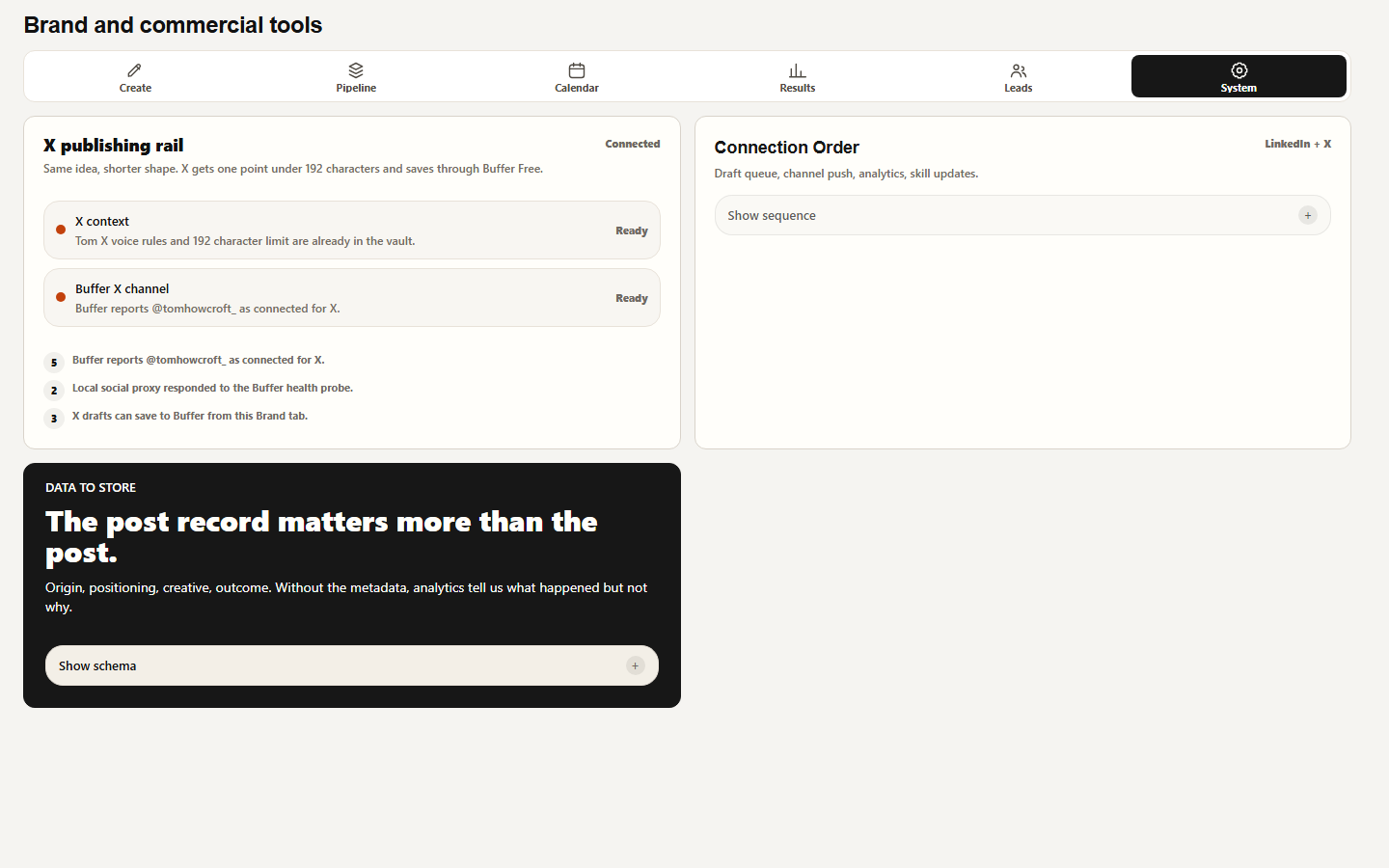
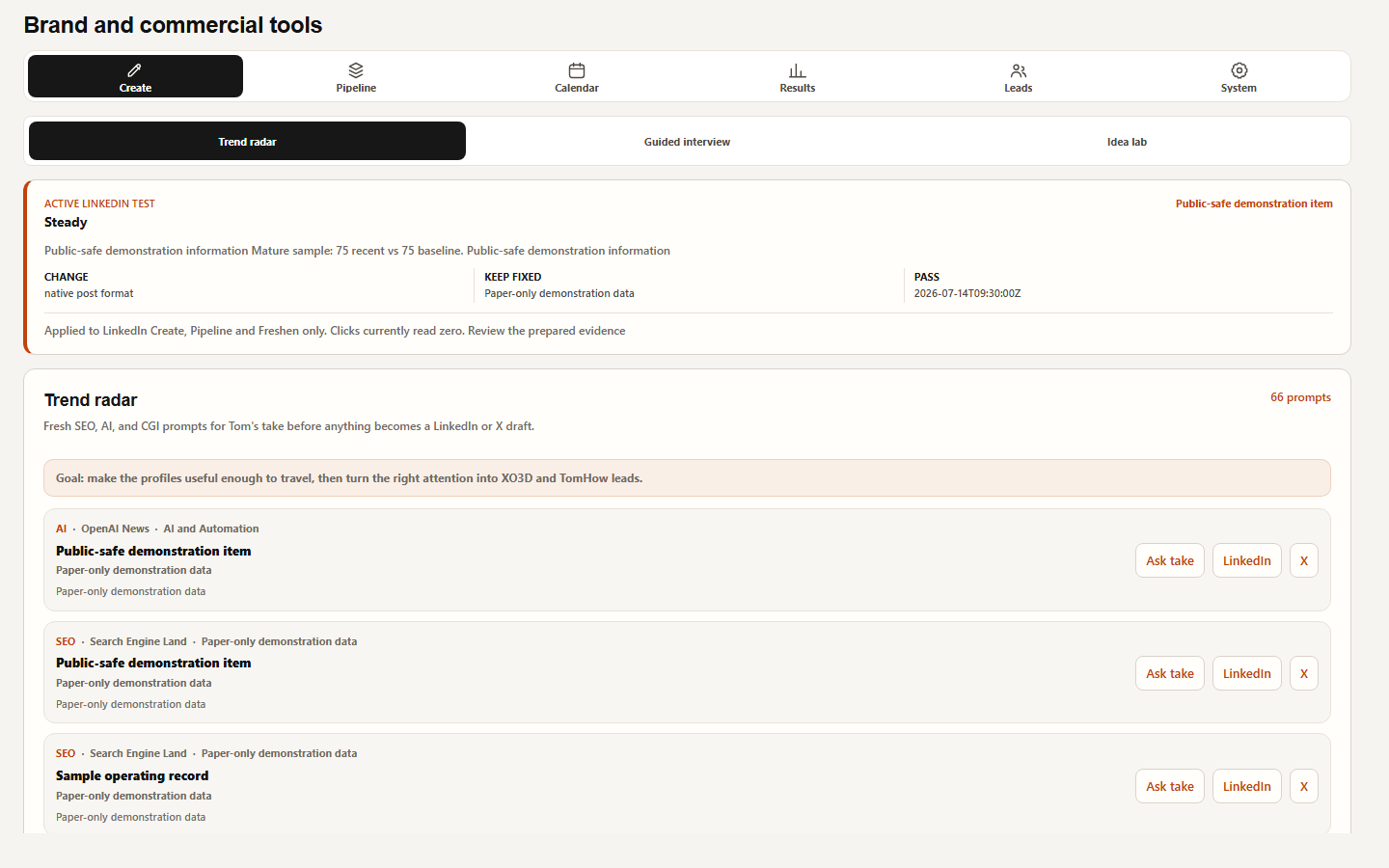
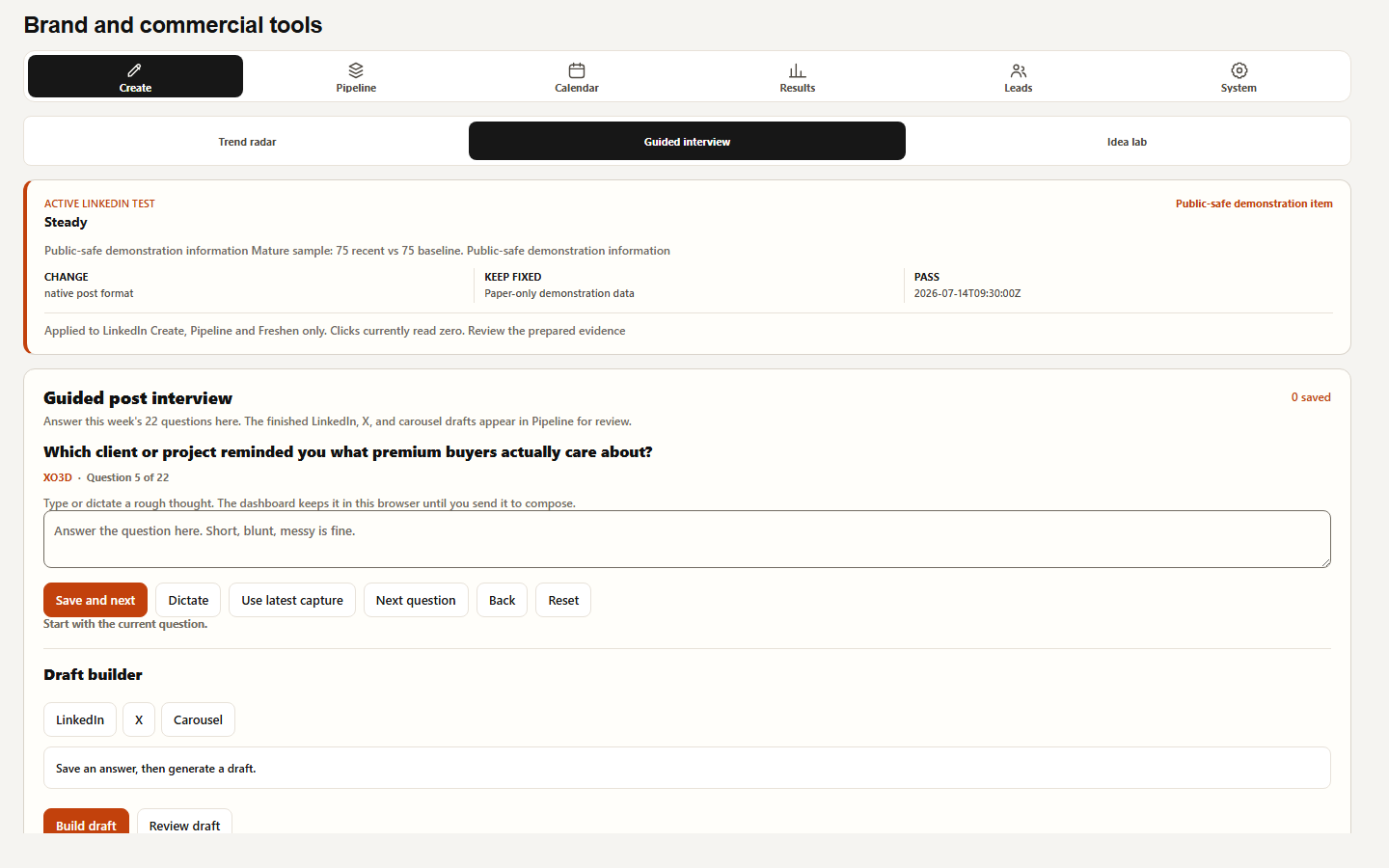
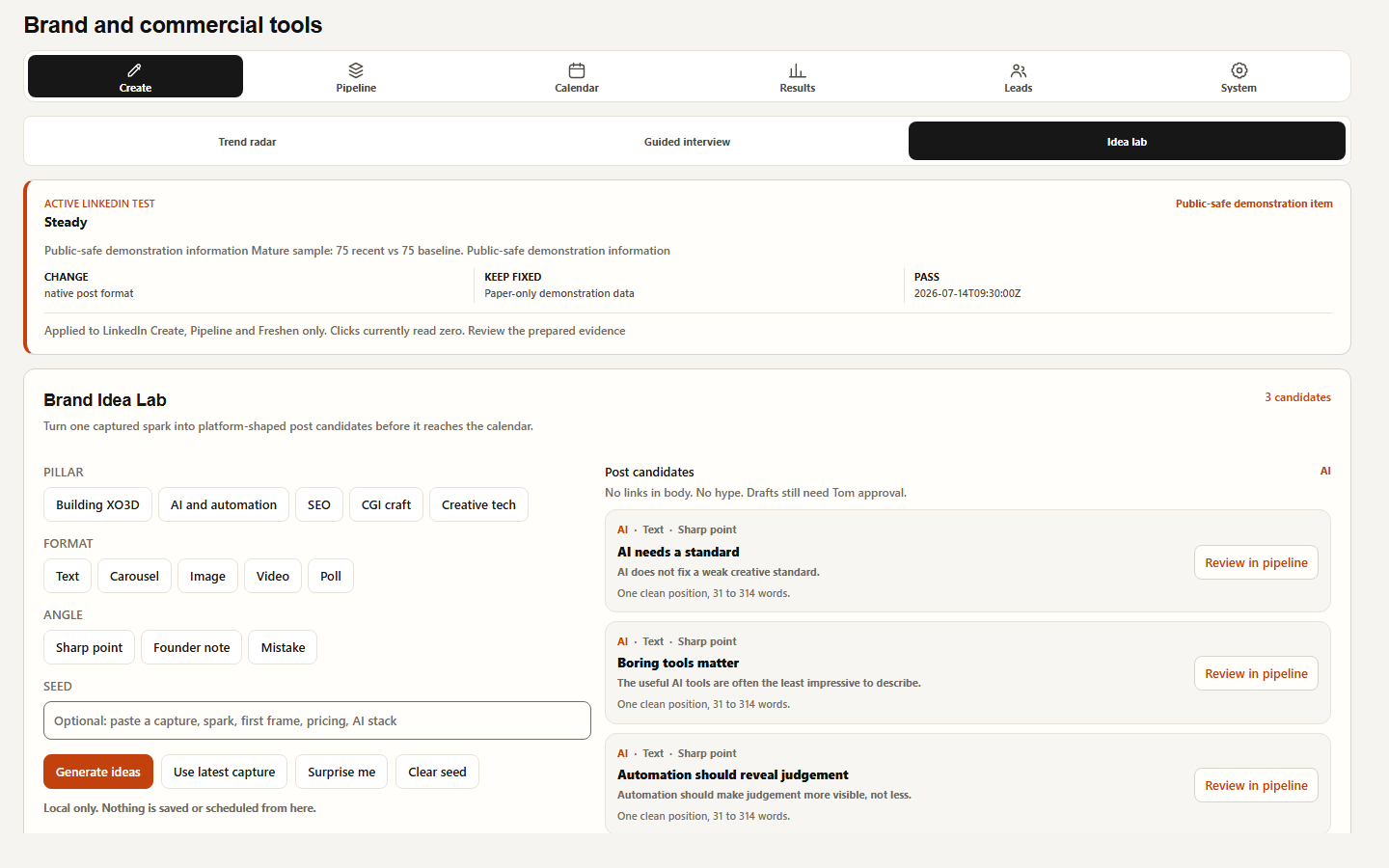
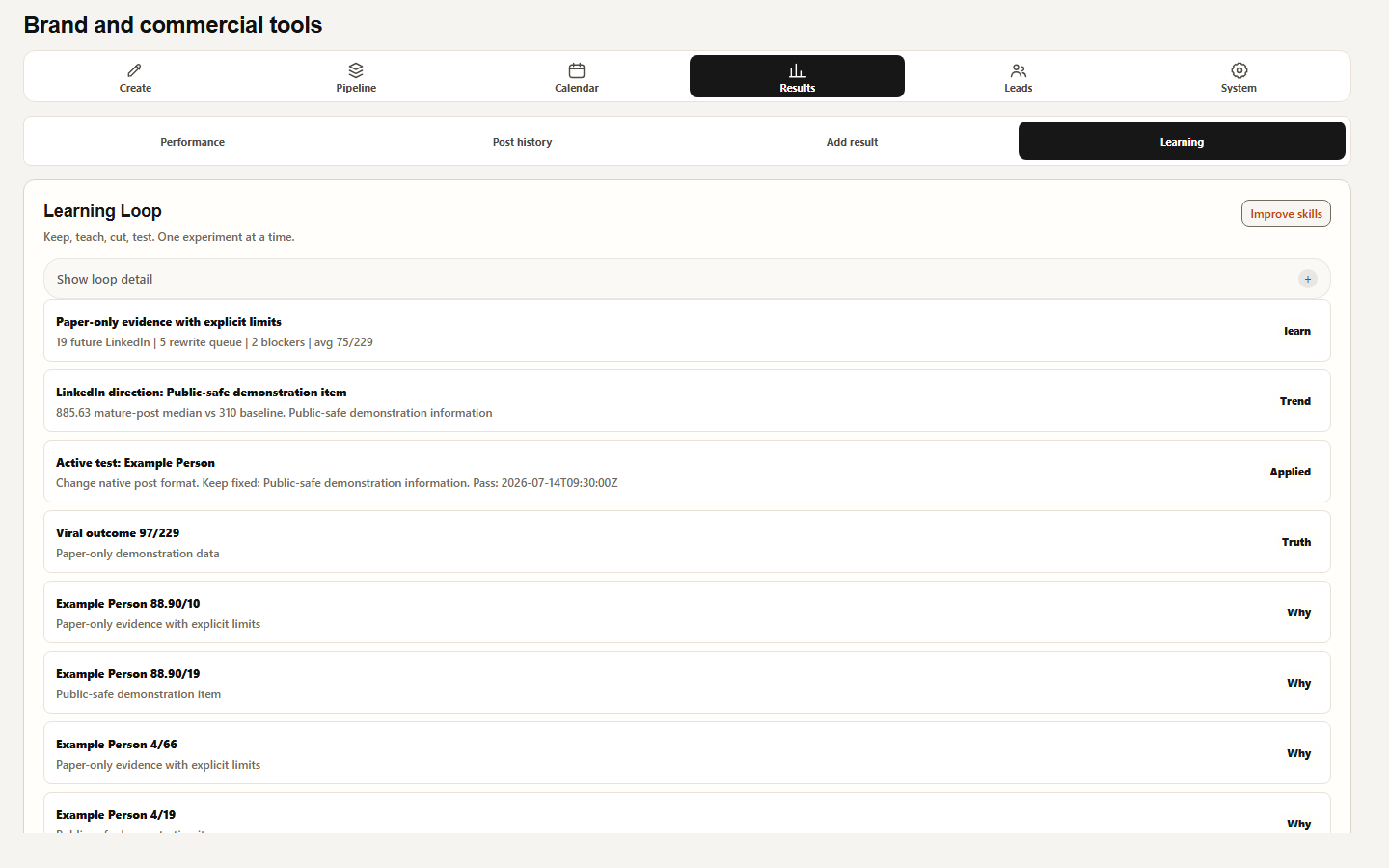
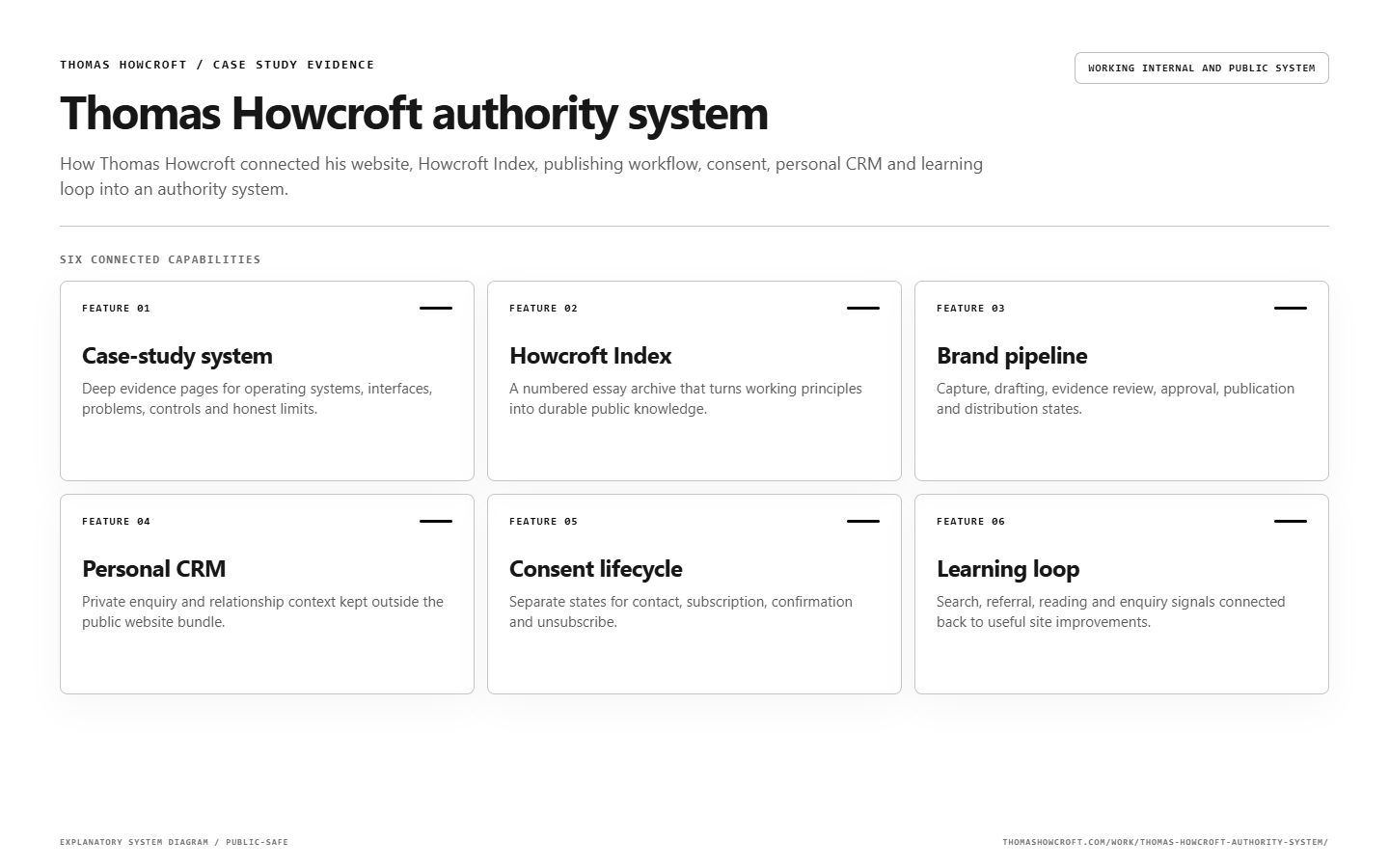
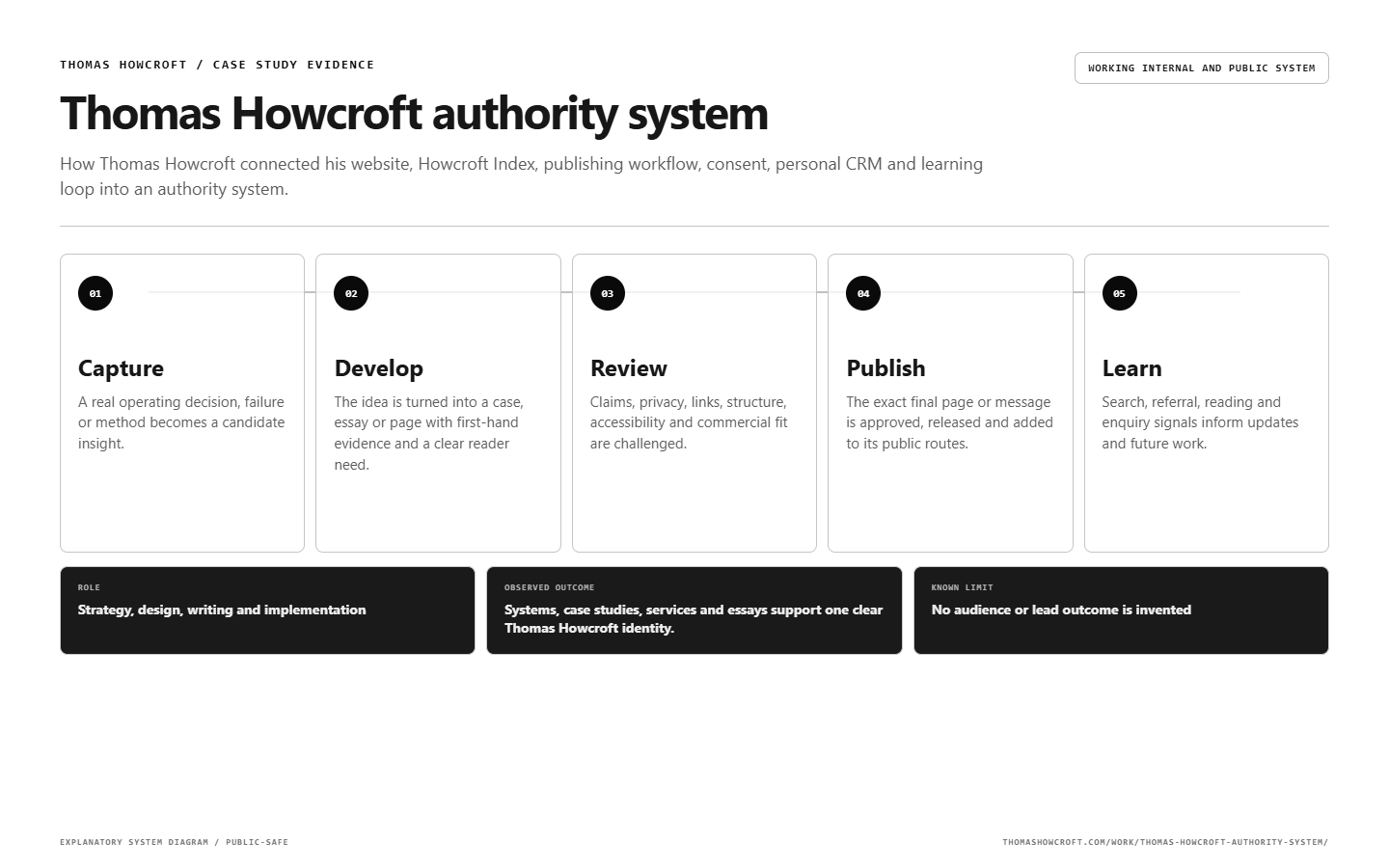
Each entry links to the exact view it describes. Product captures and explanatory diagrams retain their own evidence labels.
The real system shows how voice rules, channels, analytics and the content record connect.
Ideas and essays stay local until they move through a separate approval and publishing route.
A focused founder interview turns first-hand experience into platform-ready copy.
Captured sparks are shaped by pillar, format and angle before they enter the review pipeline.
Performance evidence becomes a keep, teach, cut or test decision.
A visual summary connects the main product capabilities to the decisions, controls and user outcomes they support.
The complete working sequence shows how information moves from the first input to a checked and reviewable outcome.
The visible dashboard is only the decision surface. Context, data, permissions, review and learning determine whether it can be trusted.
A clear commercial home for AI systems, creative direction and search expertise with evidence-led routes.
First-hand essays make operating principles durable, crawlable and useful beyond a social feed.
Capture, draft, evidence review, final review, publication and distribution use explicit states.
Subscriptions, enquiries and private relationship notes stay separate and purpose-bound.
Page, referral and enquiry evidence informs the next useful work without pretending attribution is perfect.
A useful workflow names the input, owner, check, approval boundary and proof that closes the loop.
A real operating decision, failure or method becomes a candidate insight.
The idea is turned into a case, essay or page with first-hand evidence and a clear reader need.
Claims, privacy, links, structure, accessibility and commercial fit are challenged.
The exact final page or message is approved, released and added to its public routes.
Search, referral, reading and enquiry signals inform updates and future work.
Each feature exists because it changes a decision, reduces unsafe ambiguity or makes a failure easier to see.
Deep evidence pages for operating systems, interfaces, problems, controls and honest limits.
A numbered essay archive that turns working principles into durable public knowledge.
Capture, drafting, evidence review, approval, publication and distribution states.
Private enquiry and relationship context kept outside the public website bundle.
Separate states for contact, subscription, confirmation and unsubscribe.
Search, referral, reading and enquiry signals connected back to useful site improvements.
The strongest evidence in an operating system is often the failure behaviour. These issues became design constraints and regression checks.
XO3D, TomHow and Thomas's systems work could look like unrelated identities.
Make Thomas the clear connecting operator, then route specialist work to the right business.
Publishing volume could replace useful first-hand evidence.
Start with operating work and only publish when the page earns a durable place in the authority map.
Contact, newsletter and follow-up permissions could be treated as interchangeable.
Keep each path purpose-specific and preserve its own state and evidence.
A useful CRM can contain context that must never enter public pages or analytics.
Keep private records outside the static bundle and use staged contacts in every case-study visual.
A special file or keyword pattern could be mistaken for authority.
Build the same first-hand, crawlable, well-linked evidence that helps both people and answer systems.
A public case study should make it easy to see what is working, what remains internal and what has not been proven.
The visuals combine the live public website with working internal product views. They do not claim audience, ranking, citation or lead outcomes.
Strategy, interface, governance and implementation are treated as one operating problem rather than separate deliverables.
Each link adds a different layer of first-hand evidence rather than repeating the same page under another keyword.
Practical answers about the build, its use and its limits.
It is the connected strategy, website, evidence, publishing workflow, consent, relationship context and learning loop behind a founder's public authority.
It publishes clear first-hand evidence with consistent identity, descriptive structure, crawlable links, useful images and explicit limits. It does not rely on a special AI-ranking trick.
No. The static public bundle contains no private contact records. The actual interface capture uses fictional contacts and consent states.
No. The system is live and the operating evidence is visible. Audience, ranking, citation and lead outcomes will be reported only when there is sufficient verified evidence.
A focused operating diagnostic, evidence map and pilot brief around one high-value decision. Handover: the findings, a prioritised plan and the evidence needed to decide the next step. Scope and schedule are agreed after the fit conversation.
Thomas can help turn working knowledge into a governed authority system spanning evidence, publishing, search and qualified enquiry.
