Recorded result
The published operating record covers 18 July to 19 August 2026: 411 messages staged, 224 approved and sent, 162 rejected and 5 expired. The remaining 20 were awaiting a decision at that check.
Thomas Howcroft built a governed AI operating system to keep research, reporting and outbound work connected to an owner, evidence and a human decision. It addresses a founder's practical problem: useful agent output can become unsafe or disappear between tools when responsibility is unclear. Thomas designed and operates the system, including its review paths and failure controls. Between 18 July and 19 August 2026, its email workflow staged 411 messages; 224 were approved and sent and 162 were rejected. These are historical operating records, not client revenue results. The case explains why approval is bound to the exact action, why unsupported values remain unknown, and how working interfaces expose decisions that still need attention.
Read the result, source and limits together.
The published operating record covers 18 July to 19 August 2026: 411 messages staged, 224 approved and sent, 162 rejected and 5 expired. The remaining 20 were awaiting a decision at that check.
Thomas's published Measured Results account, verified on 19 August 2026, reports the workflow's approval records. This is an operator-reported count from one internal system; private message records are not published here.
The record demonstrates reviewed outbound work at operational volume. It does not measure recipient response, incremental revenue or how another organisation would perform.
Thomas reported a typical manual preparation time of 5 to 15 minutes, reduced to seconds of hands-on review in the automated workflow. Confirmed on 20 August 2026, this is operating recollection, not a timed comparison study.
Read the dated operating figures and their sources
A general instruction to continue is too broad for an outbound workflow. The design instead ties approval to the exact recipient, content and action. Editing the draft requires review again. That adds friction, but makes the human decision inspectable and prevents an earlier approval from silently covering different work.
A direct account of the operating constraint, the product decision and the limits of the evidence.
A collection of useful automations does not become an operating system by itself. Research could be correct but disconnected from the next decision. Drafts could be good but stranded in a tool. Reporting could look complete while relying on an unsupported value. The hard problem was not generating more output. It was making the right state, owner and evidence survive between tools.
The design goal was a dependable operating layer. Every important item needed a source, an owner, a state and a route to action. Sensitive outputs needed review. Unsupported values needed to remain blank. Agents needed narrow roles, a shared standard and a visible way to fail safely.
The system was built inside live operations, then repeatedly adjusted around the places it broke: stale state, duplicate actions, unclear approval scope, overloaded dashboards and optimistic reporting. Those failures became product requirements rather than footnotes.
| Primary job | Turn disconnected AI tools into a governed operating system. |
|---|---|
| Users | Founder, trusted operators and narrowly scoped agents. |
| Core surfaces | Briefing, action review, agent activity, approvals, reporting and evaluation. |
| Control model | Evidence gates, explicit owners, approval before external action and visible failure states. |
| Public evidence | Working product views captured with public-safe demonstration records. |
These are observed properties of the working system. They are not claimed percentages, revenue attribution or a guarantee of future performance.
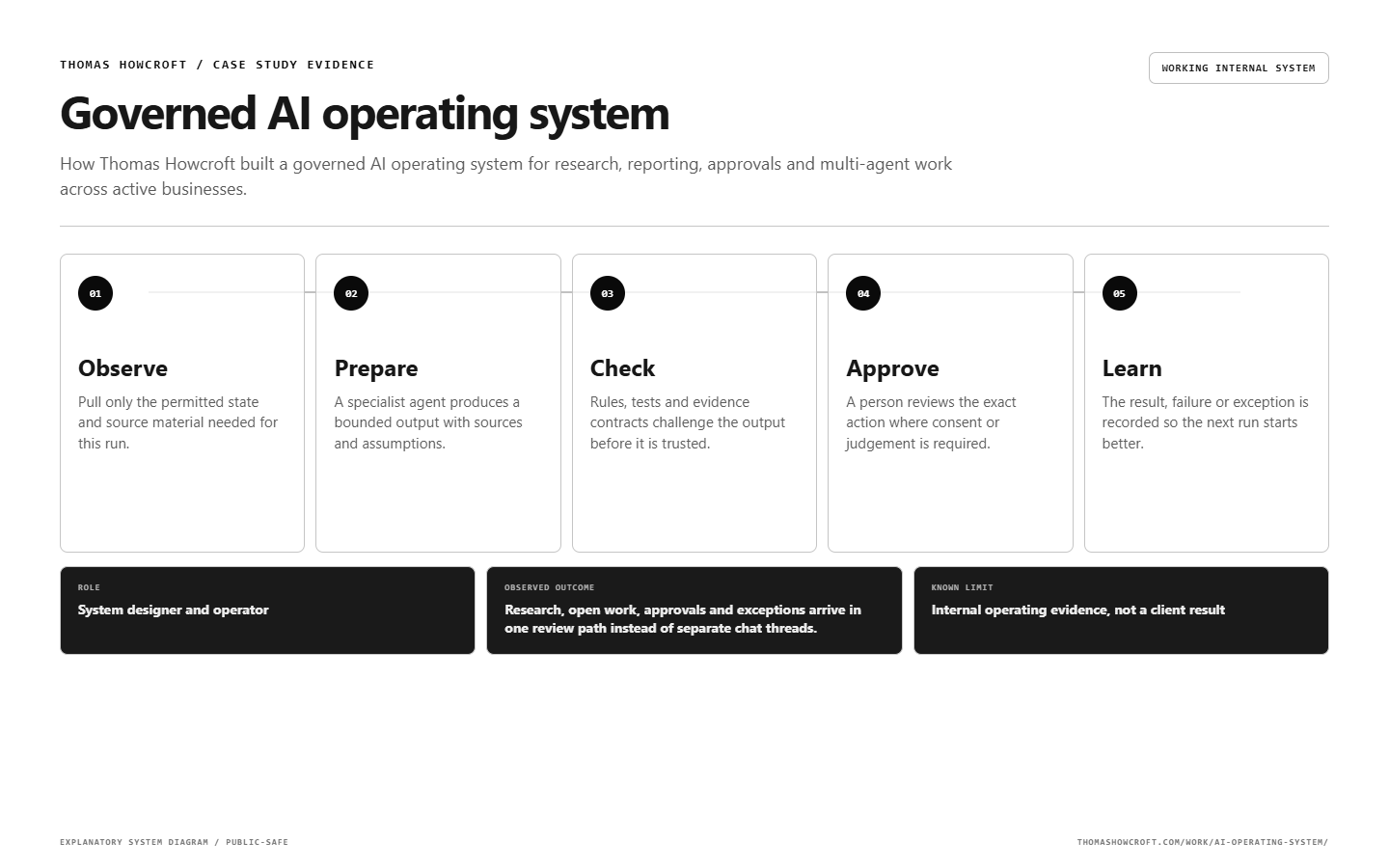
Research, open work, approvals and exceptions arrive in one review path instead of separate chat threads.
Claims that matter are attached to a source or withheld. Unknown values stay unknown.
External messages, publishing and consequential actions remain behind an exact approval step.
Blocked work, stale inputs and failed checks appear as states that can be owned and repaired.
The same rules can shape a personal dashboard, studio platform, search system or reporting workflow.
The system records what it can prove and separates operational evidence from claimed business impact.
Every image preserves the interface purpose and control logic while replacing live people, projects, records and values with staged data.

Each entry links to the exact view it describes. Product captures and explanatory diagrams retain their own evidence labels.
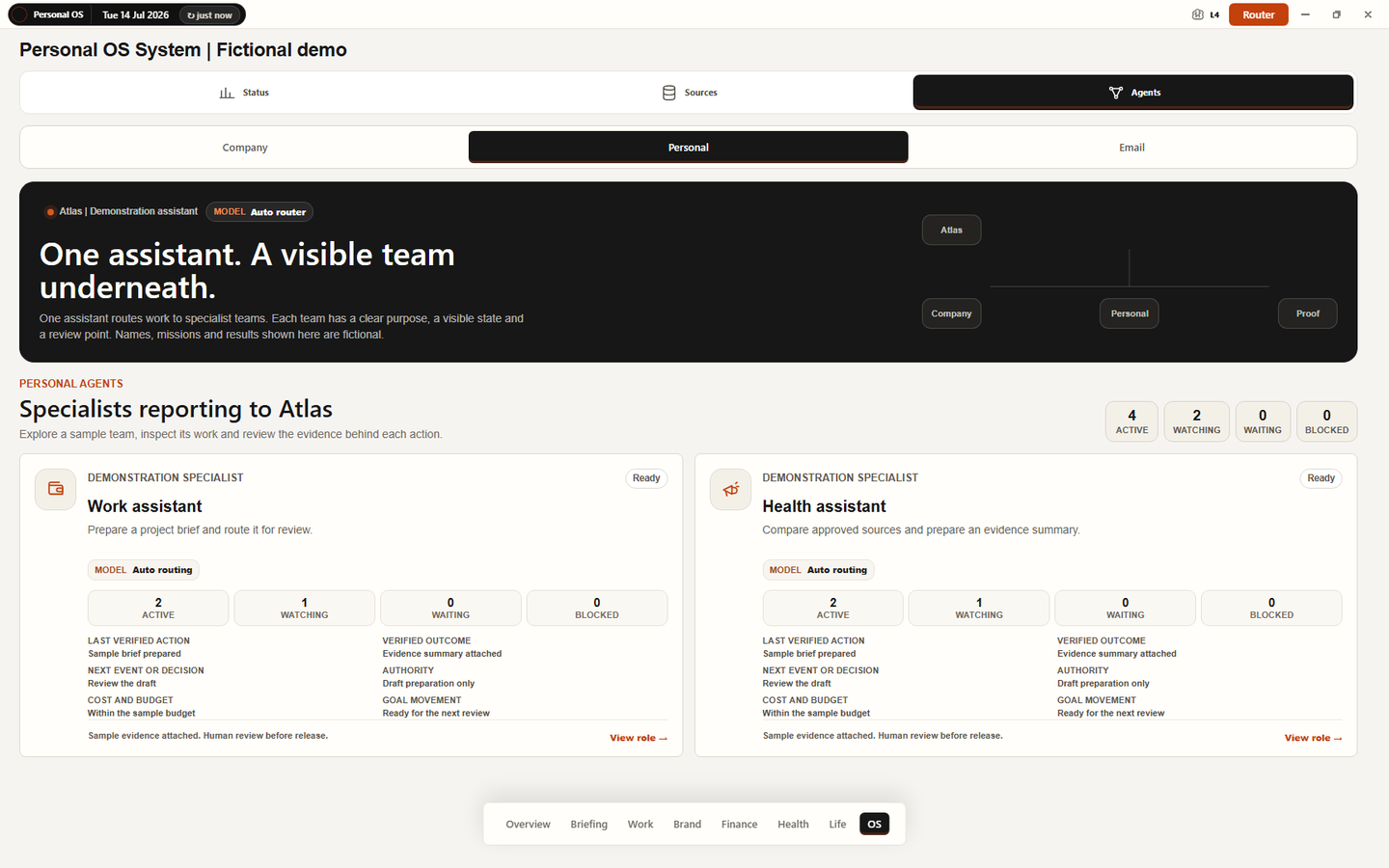
The current OS interface shows an assistant, its team diagram and specialist cards. All names, tasks and states are fictional demonstration data.
The Personal view keeps each specialist's purpose, routing and evidence together in the same operating interface, using fictional missions.
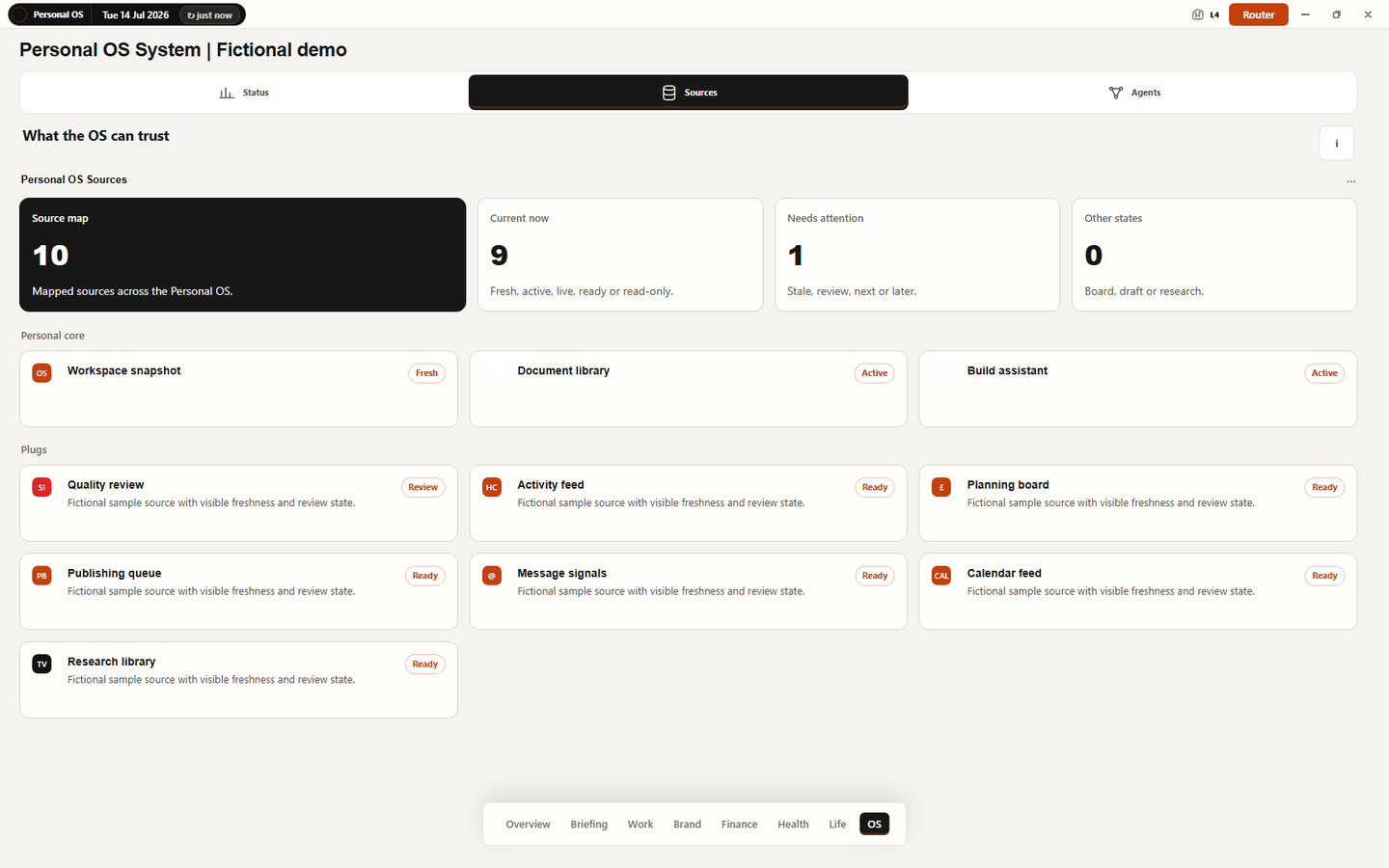
The current Sources view groups sample connections and makes their readiness visible. No private account or source details are shown.
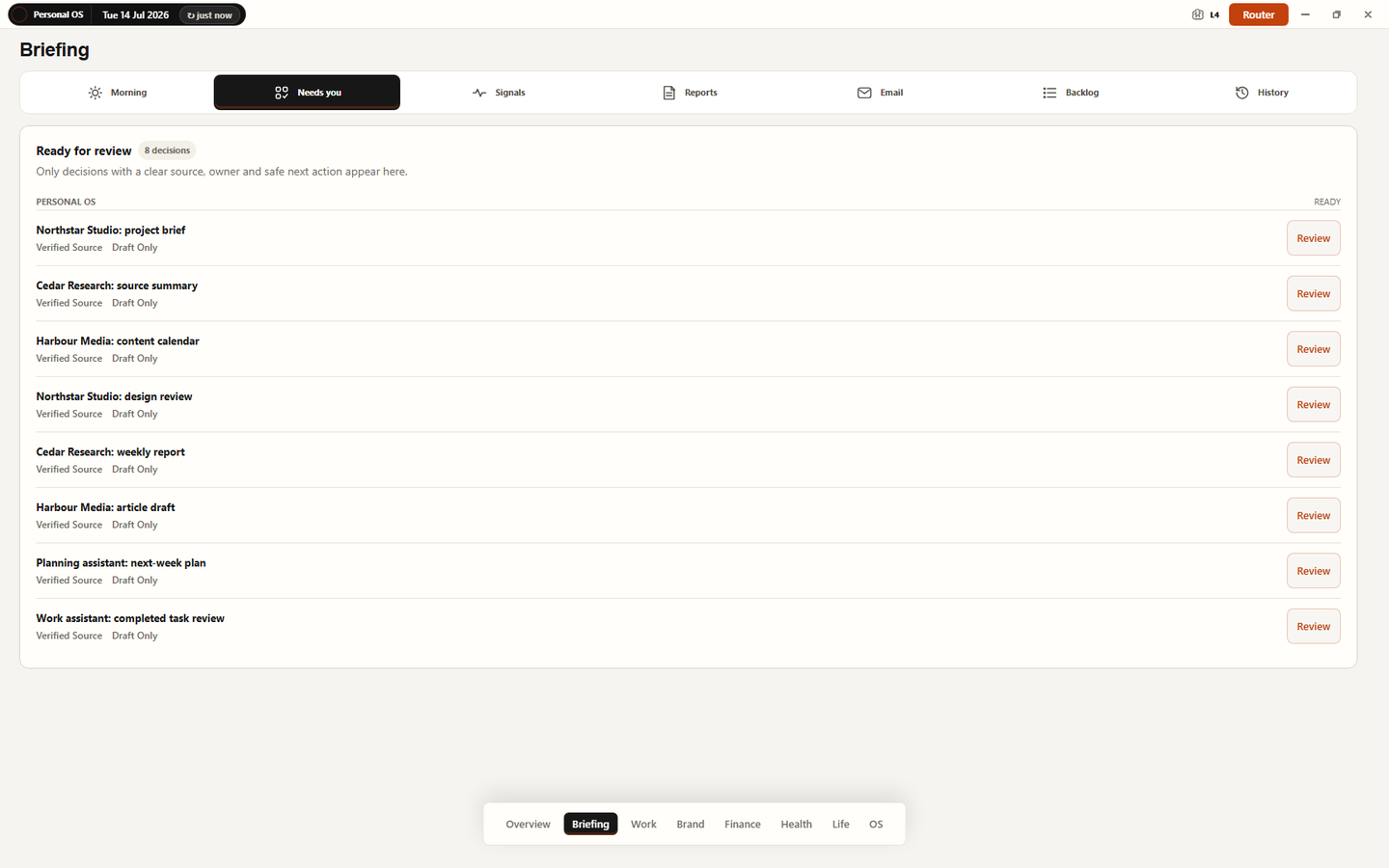
Each proposed external action carries its owner, evidence and current review state before anything can be sent or published.
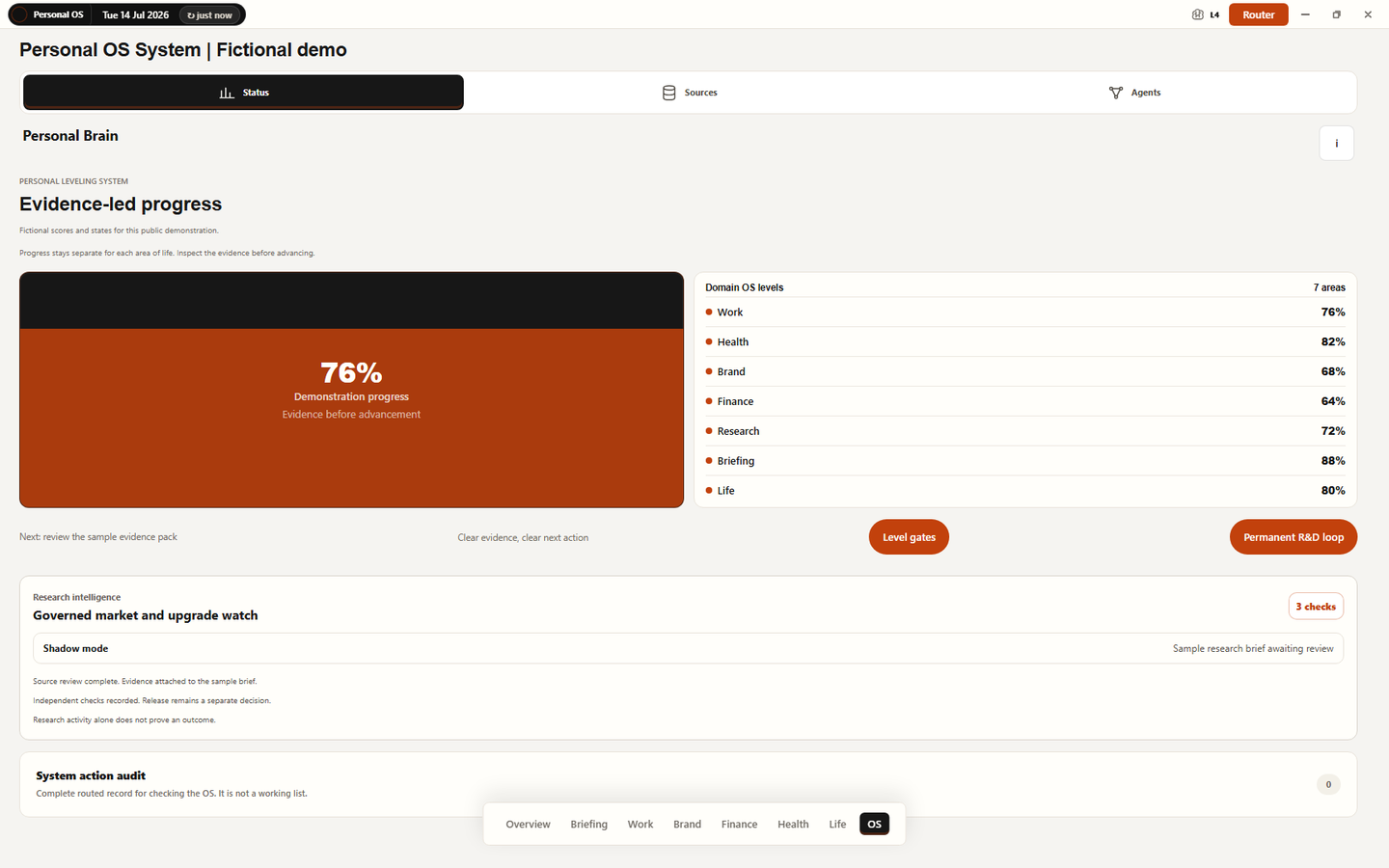
The real Status layout shows progress and separate domain states, populated with fictional data. This is an interface demonstration, not a claim about a live system score.
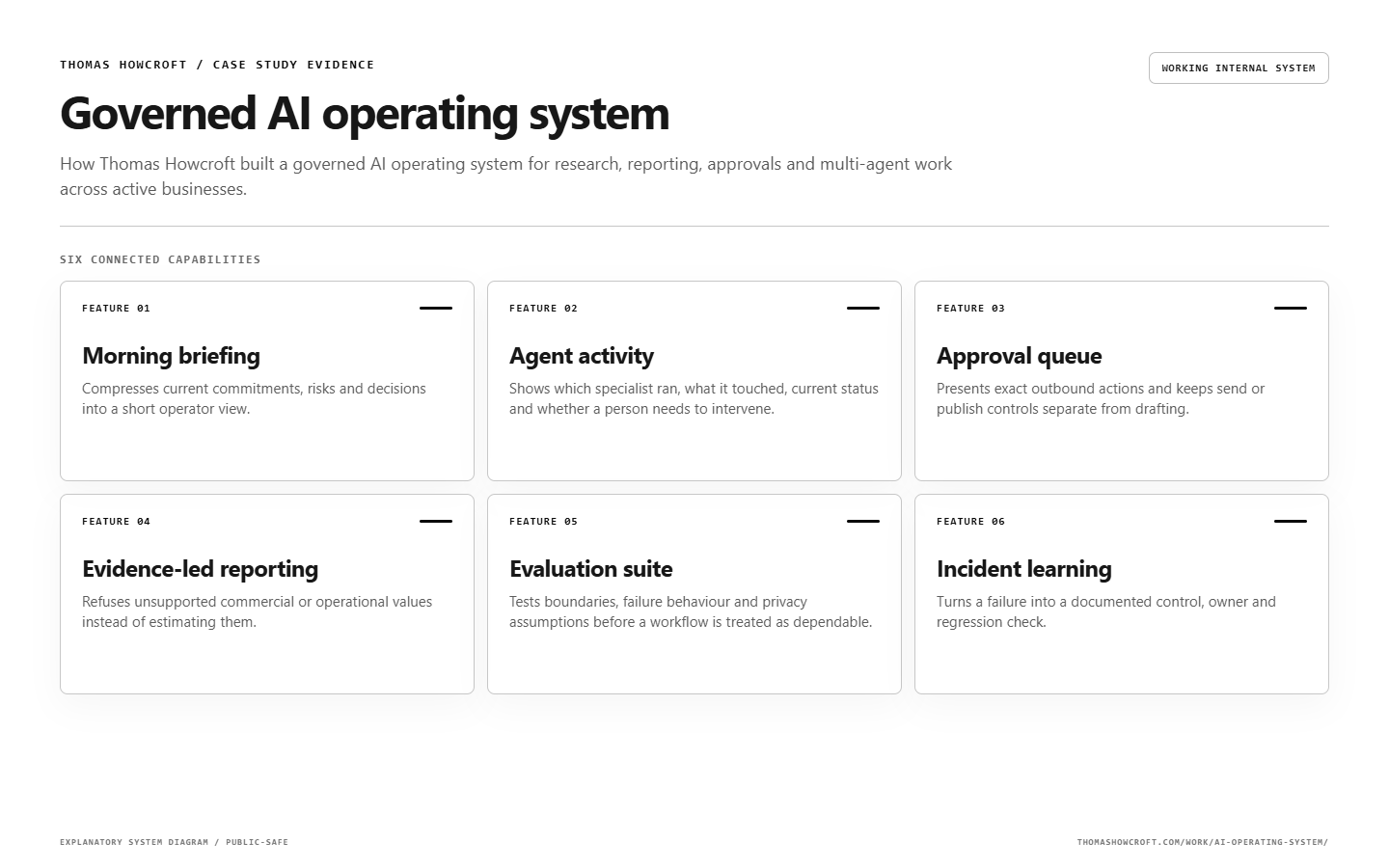
A visual summary connects the main product capabilities to the decisions, controls and user outcomes they support.
The complete working sequence shows how information moves from the first input to a checked and reviewable outcome.
The visible dashboard is only the decision surface. Context, data, permissions, review and learning determine whether it can be trusted.
Stable rules, project truth and current state are separated so an agent gets the right context without receiving everything.
Narrow agents research, check, draft, compare or prepare. Their responsibilities do not overlap by accident.
Important values have a type, provenance and freshness expectation. Missing evidence cannot silently become a number.
The system stages external or consequential actions with the exact payload, intended recipient and current proof.
Automated checks, adversarial cases and human review turn failures into better controls and clearer operating rules.
A useful workflow names the input, owner, check, approval boundary and proof that closes the loop.
Pull only the permitted state and source material needed for this run.
A specialist agent produces a bounded output with sources and assumptions.
Rules, tests and evidence contracts challenge the output before it is trusted.
A person reviews the exact action where consent or judgement is required.
The result, failure or exception is recorded so the next run starts better.
Each feature exists because it changes a decision, reduces unsafe ambiguity or makes a failure easier to see.
Compresses current commitments, risks and decisions into a short operator view.
Shows which specialist ran, what it touched, current status and whether a person needs to intervene.
Presents exact outbound actions and keeps send or publish controls separate from drafting.
Refuses unsupported commercial or operational values instead of estimating them.
Tests boundaries, failure behaviour and privacy assumptions before a workflow is treated as dependable.
Turns a failure into a documented control, owner and regression check.
The strongest evidence in an operating system is often the failure behaviour. These issues became design constraints and regression checks.
Different tools held different versions of the truth.
Separate stable context from live state, name the owner and refresh volatile inputs at the point of use.
Useful work disappeared inside long conversations.
Give every real action a destination, state and review path. Chat is not the task system.
A polished dashboard could make unsupported values look authoritative.
Require typed evidence and let the interface show unknown, blocked or stale states without filling the gap.
A general yes could be interpreted too broadly.
Stage the exact recipient, payload and action. Approval applies only to that packet.
Several agents could research or change the same thing.
Define narrow responsibilities, single ownership and explicit handoffs between stages.
A public case study should make it easy to see what is working, what remains internal and what has not been proven.
The visuals are captures from the working private system with demonstration data. They do not represent a public software release or a client result.
Strategy, interface, governance and implementation are treated as one operating problem rather than separate deliverables.
Each link adds a different layer of first-hand evidence rather than repeating the same page under another keyword.
Practical answers about the build, its use and its limits.
It is the operating layer around AI tools: trusted context, defined workflows, evidence, owners, controls, evaluation and a route from output to a real decision.
No. It is a governed system made from interfaces, automations, written standards, data contracts and human review points. The parts can change without losing the operating model.
Drafting and preparation can be automated. External or consequential actions remain behind exact approval unless a narrow low-risk action has been explicitly authorised.
It proves that the system and controls operate in Thomas's own working environment. It does not claim an external client result or a guaranteed commercial outcome.
Review one research, reporting or outbound workflow. Handover: a source-and-owner map, approval boundaries, failure cases and a prioritised pilot brief. The decision at the end is whether to pilot, redesign or leave the workflow manual. Scope and schedule are agreed after the fit conversation.
Thomas helps leadership teams define the decision, build a governed workflow, evaluate it under real conditions and create the operating rules needed to adopt it safely.